Chapter 2: The promises
Does God keep his promises? · About 45 minutes · Grades 1–5
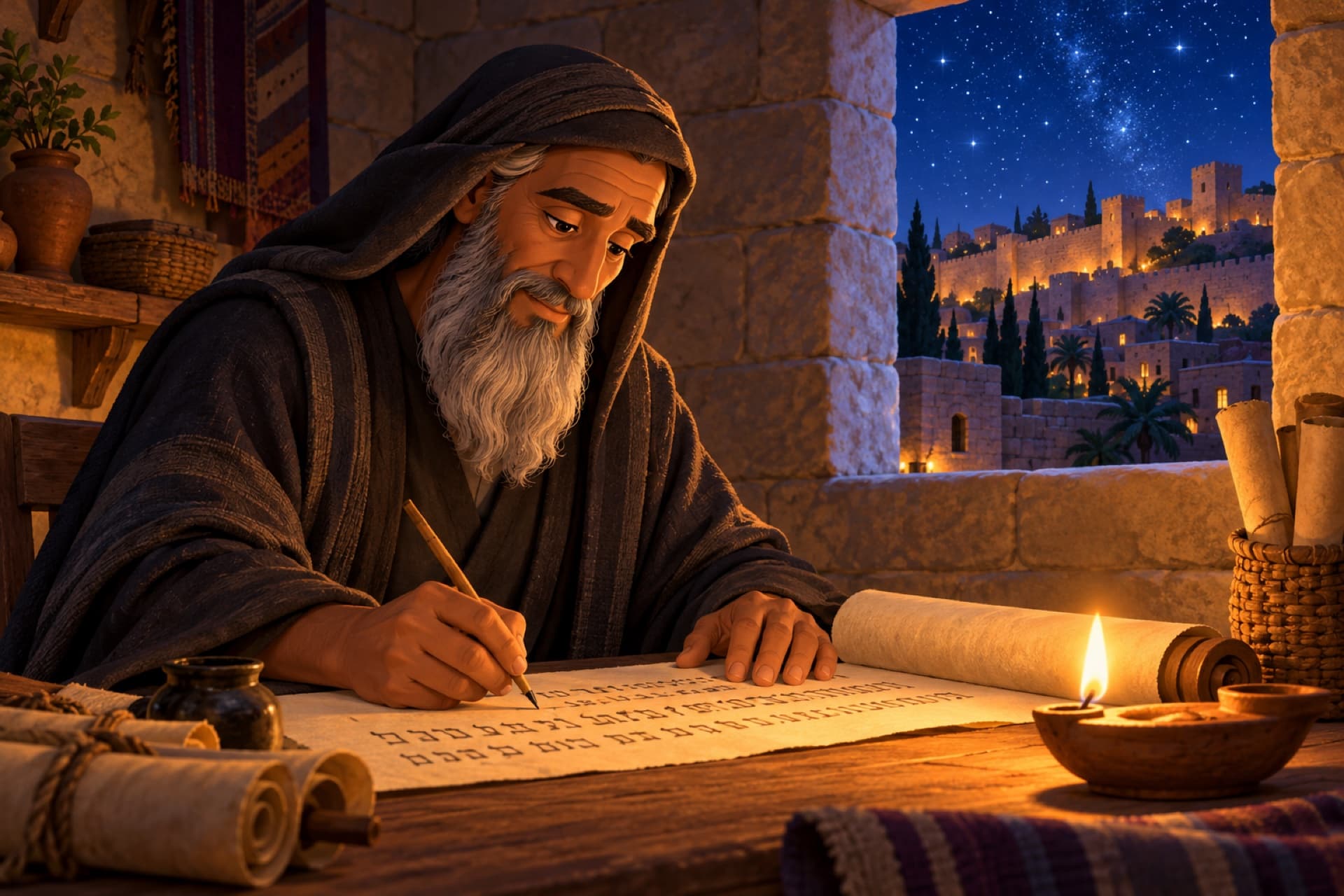
 The Evidence for Jesus · A lesson for grades 1–5
The promises
Big questionDoes God keep his promises?
By the end, kids can
- Tell how Jesus fit promises written down long before he was born: a servant who suffers, a ruler from Bethlehem, a king on a donkey, lots cast for his clothes, and Daniel's deadline.
- Explain why the Isaiah scroll from the Dead Sea Scrolls shows Isaiah's poem was written before Jesus.
- Say the memory verse: Joshua 21:45 (grades 3–4: Isaiah 53:5; grade 5: Isaiah 53:5–6).
- Know that God keeps his promises, and that Jesus came to carry our wrongs.
You'll need
- The worksheet for each child's level (grades 1–2, 3–4, or 5), handed out at the start
- Bibles for the look-ups (grades 3–5)
- Pencils and crayons
- A screen with sound and internet: each promise plays its part of the Chapter 2 video
- An envelope with a promise sealed inside (see the warm-up), and a small treat or sticker for each child to keep it
The lesson
- 3 min Warm-up: a sealed promise, and could you guess this?
- 2 min Memory verse
- 10 min Promise 1, a servant who suffers: watch (3½ minutes), five matches, and line up the dates
- 7 min Promise 2, where, how, and what: watch (2 minutes), act it out, match the promises, and nobody saw it coming
- 5 min Promise 3, a deadline: watch (2 minutes), then talk
- 4 min Put the promises together, the word search, and a quick check
- 6 min Going deeper (grades 3–5): run Daniel's clock, and “isn't that about Israel?”
- 4 min Good news: why he came
- 4 min Memory verse again, talk, pray, and open the envelope
Worksheets
Print one for each child, at their level. They fill it in as you go: the ✎ Worksheet sticker on a slide says which part goes with it.
Answer key
Each worksheet page prints its answers upside down at the foot. Here they all are, and on the slide before the credits.
Grades 1–2
- Page 1: Promise kept! 1-C · 2-D · 3-A · 4-B
- Page 2: Joshua 21:45: good, promises, fulfilled
- Page 2: Word search: Find: PROMISE, JESUS, DONKEY, KING, ISAIAH, TRUE
Grades 3–4
- Page 1: Promise kept! 1-C · 2-E · 3-F · 4-A · 5-D · 6-B
- Page 2: Isaiah 53:5: pierced, crushed, peace, wounds
- Page 2: Word search: Find: BETHLEHEM, ZECHARIAH, PROPHET, SERVANT, PROMISE, DONKEY, SCROLL, ISAIAH, MICAH
Grade 5
- Page 1: Run Daniel's clock: 69, 483, 26, 27, 40, yes
- Page 2: Isaiah 53:5–6: pierced, crushed, healed, astray, laid
- Page 2: Think it through: Answers will vary. Look for: 1. copied by 125 BC, before Jesus 2. innocent; suffers for his people 3. his birthplace, the dice, the tomb 4. Messiah before AD 70: Jesus
Presenting
Each clue opens with a ▶ Watch slide that plays its part of the 9-minute Chapter 2 video right on the slide: read the two questions, then click (or press →, or use a clicker) to play the clip. The slides wait while it plays and stops by itself; click twice to stop it early. Then click to show the answers. The clips need an internet connection.
Click the slide, or press → or Space (a clicker works too), to show the next thing; ← goes back, even while a clip plays. F presents full screen (Esc leaves it). P opens the presenter view, a second window with your notes, the next slide, and a timer, that moves with the slides: put it on your laptop and the slides on the projector. N shows the notes under the slides.
Your script
The promises
Say: Last time we asked if anyone is there. Today's question goes one step further: if God is real, has he ever spoken? And does he keep his promises?
Say: The Bible says God made promises hundreds of years ahead. We're going to check them against what actually happened, like detectives.
Could you guess this?
Do: Before class, write a promise on a card, like “Before we go home today, everyone will get a sticker,” and seal it in an envelope. Now hand the envelope to a child to keep safe until the end. Say: I wrote down a promise before you came. We'll open it at the end and see if I kept it.
Ask: Could you guess the town where someone will be born 500 years from now? (No! Nobody could.)
Say: A prophet named Micah did something like that. He wrote down the small town where Israel's ruler would come from. Keep your guess in mind: we'll find out at promise two.
Clicks: 1. the line “Nobody could guess that. But God told his prophets, and they wrote it down.”
Sources: Micah 5:2 · Matthew 2:1
Memory verse
Do: Read it together three times. Then add motions: “not one” (shake your head and hold up one finger), “good promises” (thumbs up), “failed” (thumbs down), “every one was fulfilled” (sweep your arms wide, then clap).
Say: Joshua wrote this after God had brought his people into the land he promised them. God kept every promise. Today we'll see him keep some more.
Older kids: Grades 3–4 learn Isaiah 53:5 and grade 5 learns Isaiah 53:5–6. Both are on their worksheets.
Promise 1 · Watch: A servant who suffers
Say: Promise one is a poem. A prophet named Isaiah wrote it about 700 years before Jesus.
Do: Read the two questions out loud, then click to play the clip. It's about 3½ minutes and stops by itself.
Ask after: How long before Jesus did Isaiah write? What did the shepherd find? Click once for each answer.
Clicks: 1. play the clip (it stops by itself) · 2. the answer to 1: About 700 years. · 3. the answer to 2: Tall jars full of old scrolls, with a whole copy of Isaiah.
Sources: Read Isaiah 52:13–53:12 · The Dead Sea Scrolls · The Great Isaiah Scroll
One poem, five matches
Say: Let's line up Isaiah's poem with what happened to Jesus. Click once for each match, and read Isaiah's words out loud first.
Say: 1. Isaiah: “He was pierced for our transgressions.” Jesus was nailed to a cross, and a soldier pierced his side with a spear.
Say: 2. Isaiah: “He was oppressed and afflicted, yet he did not open his mouth.” Before the chief priests, Pilate, and Herod, Jesus gave no answer.
Say: 3. Isaiah: “He was numbered with the transgressors.” Jesus was crucified between two rebels, one on his right and one on his left.
Say: 4. Isaiah: “He was assigned a grave with the wicked, and with the rich in his death.” A rich man, Joseph of Arimathea, laid Jesus's body in his own new tomb.
Say: 5. Isaiah: “After he has suffered, he will see the light of life.” Three days later, the tomb was empty.
Ask: Could Jesus have arranged the last two himself? (No. They happened after he died.)
Clicks: 1. step 1 · 2. step 2 · 3. step 3 · 4. step 4 · 5. step 5 · 6. the line at the bottom
Sources: Isaiah 53:5 · John 19:31–37 · Isaiah 53:7 · Matthew 27:12–14 · Isaiah 53:12 · Mark 15:27 · Isaiah 53:9 · Matthew 27:57–60 · Isaiah 53:11 · Luke 24:1–6
Written down first
Say: Some people say Christians wrote Isaiah's poem after Jesus, to fit his story. Then a young shepherd found a cave in the cliffs near the Dead Sea.
Say: Eleven caves gave up nearly a thousand scrolls. This is a real photo of the Great Isaiah Scroll: all sixty-six chapters, chapter 53 included. It's in a museum in Jerusalem today.
Ask: If this copy was made before Jesus was born, could anyone have written the poem to fit him? (No. The words came first.)
Clicks: 1. the line “This is one of them: the whole book of Isaiah, copied around 125 BC, more than 100 years before Jesus was born.”
Sources: The Dead Sea Scrolls · The Great Isaiah Scroll · The Great Isaiah Scroll (Israel Museum)
Line up the dates
Do: Before each click, ask what happened in that year. Then click to check.
Say: Isaiah preached in the 700s BC. This copy was made around 125 BC. Jesus was crucified around AD 30. And the scroll waited in a cave near the Dead Sea, like the ones in this photo, until 1947.
Clicks: 1. 700s BC: Isaiah preaches · 2. 125 BC: The scroll is copied · 3. AD 30: Jesus is crucified · 4. 1947: The scroll is found · 5. the line at the bottom
Sources: Isaiah 1:1 · The Great Isaiah Scroll
Promise 2 · Watch: Where, how, and what
Say: Other prophets added details: where he'd be born, how he'd arrive, and even what would happen to his clothes.
Do: Read the two questions out loud, then click to play the clip. It's about 2 minutes.
Ask after: Where would he be born? How would he ride in? Click once for each answer.
Clicks: 1. play the clip (it stops by itself) · 2. the answer to 1: Bethlehem, a small town. · 3. the answer to 2: On a donkey, not a warhorse.
Sources: Micah 5:2 · Zechariah 9:9 · Psalm 22:18 · Luke 18:31–34
Three more promises
Say: Micah named a small town, not the capital: Bethlehem. Zechariah said the king would come “lowly and riding on a donkey.” David wrote, “They divide my clothes among them and cast lots for my garment.”
Say: Jesus was born in Bethlehem. He rode into Jerusalem on a young donkey. At the cross, soldiers split up his clothes and cast lots for the last piece.
Do: Act it out. Pick one child to be the king riding in on a donkey, and have everyone else wave pretend palm branches and shout, “Blessed is the king of Israel!”
Ask: Which of these could Jesus arrange himself? (The donkey: he chose to ride one. Not the town where he was born, and not what soldiers did with his clothes.)
Worksheet: Grades 1–2 and 3–4 draw lines on page 1 now, from each promise to what happened.
Worksheet answers: Grades 1–2, Page 1: Promise kept!: 1-C · 2-D · 3-A · 4-B
Worksheet answers: Grades 3–4, Page 1: Promise kept!: 1-C · 2-E · 3-F · 4-A · 5-D · 6-B
Clicks: 1. the card “Born in Bethlehem” · 2. the card “A king on a donkey” · 3. the card “Lots cast for his clothes” · 4. the line at the bottom
Sources: Micah 5:2 · Matthew 2:1 · Zechariah 9:9 · John 12:12–15 · Psalm 22:18 · John 19:23–24
Nobody saw it coming
Say: Couldn't Christians have gone hunting for matches afterward? Here's why that's hard to believe. A Jewish prayer written decades before Jesus asks God to “raise up unto them their king, the son of David… that he may shatter unrighteous rulers.” They expected a king, not a cross.
Say: When Jesus told his friends he would be killed and rise again, “the disciples did not understand any of this.” Only after he rose did they realize “that these things had been written about him.”
Ask: If nobody expected a Messiah who would die, could anyone have planned all this to make it look like the promises came true? (No.)
Clicks: 1. the line “Even Jesus's friends didn't understand until after he rose. Nobody was acting out a script.”
Sources: Psalms of Solomon 17, tr. G. Buchanan Gray (1913) · Luke 18:31–34 · John 12:16
Promise 3 · Watch: Daniel's countdown
Say: Promise three came with a clock. Daniel was an old man far from home, in Babylon, praying for his ruined city.
Do: Read the two questions out loud, then click to play the clip. It's about 2 minutes. With grades 1–2, keep it simple: God gave Daniel a clock, and it ran out when Jesus came.
Ask after: Who gave Daniel the countdown? What had to happen before the Temple fell? Click once for each answer.
Clicks: 1. play the clip (it stops by itself) · 2. the answer to 1: The angel Gabriel. · 3. the answer to 2: The Anointed One, the Messiah, had to come and be put to death.
Sources: Read Daniel 9 · Messiah means “anointed” · The siege of Jerusalem, AD 70
A deadline
Do: Count it together. Hold up seven fingers for one “seven,” and clap seven times. Now imagine doing that sixty-nine times: 483 years.
Say: “The Anointed One” is mashiach in Hebrew: the Messiah. In Greek it's Christos: Christ.
Say: This carving is on the Arch of Titus in Rome, built to celebrate Rome's victory over Jerusalem. The soldiers are carrying off the Temple's lampstand, the menorah.
Ask: If the Messiah had to come and die before the Temple fell, and it fell in AD 70, when did he have to come? (Before AD 70. Jesus came, and was killed, before the Temple fell.)
Clicks: 1. the line “Jesus was crucified around AD 30. Rome destroyed the Temple in AD 70.”
Sources: Daniel 9:26 · The Arch of Titus · The siege of Jerusalem, AD 70
God keeps his promises
Say: Put the promises together. A servant pierced for others, written about 700 years early and copied out more than a century before Jesus. A small town, a donkey, his clothes. A deadline that ran out before the Temple fell. Jesus fits them all.
Say: And nobody was acting out a script. His own friends didn't understand until after he rose: “Only after Jesus was glorified did they realize that these things had been written about him.”
Worksheet: Grades 1–2 and 3–4 do the word search on page 2 now.
Worksheet answers: Grades 1–2, Page 2: Word search: Find: PROMISE, JESUS, DONKEY, KING, ISAIAH, TRUE
Worksheet answers: Grades 3–4, Page 2: Word search: Find: BETHLEHEM, ZECHARIAH, PROPHET, SERVANT, PROMISE, DONKEY, SCROLL, ISAIAH, MICAH
Clicks: 1. the card “A servant who suffers” · 2. the card “Written down first” · 3. the card “Bethlehem, a donkey, his clothes” · 4. the card “A deadline” · 5. the line at the bottom
Sources: John 12:16 · The Great Isaiah Scroll
True or false?
Do: Read each one and have kids stand up for true and sit down for false. Click to stamp each answer.
Answers: 1. False, a copy was made around 125 BC. 2. True. 3. False, they understood only afterward. 4. True.
Clicks: 1. the answer to 1: False. A copy was made around 125 BC, before Jesus was born. · 2. the answer to 2: True. · 3. the answer to 3: False. They didn't understand until afterward. · 4. the answer to 4: True.
Run Daniel's clock
Do: Work it out together, one click at a time. Ask the answer to each sum first, then click to check: seven plus sixty-two (69), sixty-nine times seven (483).
Say: Christians count it a few ways. The most common starts in 457 BC, when King Artaxerxes sent Ezra back to restore Jerusalem. Count 483 years and you reach AD 27, with no year 0 in between.
Say: Luke dates the start of Jesus's work to about AD 28 or 29. He was crucified around AD 30. Forty years later, in AD 70, Rome destroyed the city and the Temple, in the order Daniel gave.
Worksheet: Grade 5 runs the clock on page 1 now.
Worksheet answers: Grade 5, Page 1: Run Daniel's clock: 69, 483, 26, 27, 40, yes
Clicks: 1. 7 + 62: 69 sevens · 2. 69 × 7: 483 years · 3. 457 BC: Ezra sent · 4. AD 27: 483 years on · 5. AD 30: Jesus crucified · 6. AD 70: Temple destroyed · 7. the line at the bottom
Sources: Daniel 9:24–27 · Ezra 7 · Luke 3:1–23 · Prophecy of Seventy Weeks
“Isn't that about Israel?”
Say: The medieval rabbi Rashi wrote: “So is the custom of this prophet: he mentions all Israel as one man.”
Say: But read the poem. The servant “had done no violence, nor was any deceit in his mouth.” And “for the transgression of my people he was punished.” He suffers for his people, in their place.
Say: The first Christians met this question head on. An official from Ethiopia was reading this very passage in his chariot and asked, “Who is the prophet talking about, himself or someone else?” Philip began with that passage and told him the good news about Jesus.
Worksheet: Grade 5 answers the questions on page 2 now.
Worksheet answers: Grade 5, Page 2: Think it through: Answers will vary. Look for: 1. copied by 125 BC, before Jesus 2. innocent; suffers for his people 3. his birthplace, the dice, the tomb 4. Messiah before AD 70: Jesus
Clicks: 1. the line “But this servant is innocent, and he suffers for his people, not with them.”
Sources: Rashi on Isaiah 53 (Sefaria) · Isaiah 49:3 · Isaiah 53:8–9 · Acts 8:26–35
Why he came
Say: The same poem tells us why he came. We've all gone our own way, like sheep that wander off. And God laid our wrongs on him.
Ask: What does it mean that we've gone astray like sheep? (We've each gone our own way instead of God's.)
Say: After he rose, Jesus walked with two of his followers on a road and showed them this himself: “Beginning with Moses and all the Prophets, he explained to them what was said in all the Scriptures concerning himself.”
Say: The God who kept all these promises keeps his promise to forgive everyone who comes to him through Jesus. Tonight, older kids, read Isaiah 53 for yourself and ask: who is this about?
Clicks: 1. the line “Jesus came to carry the wrong things we've done. God kept that promise too.”
Sources: Isaiah 53:6 · Luke 24:13–27
Say it again
Do: Say the verse together, filling in the missing words. Then try it with eyes closed.
Answers: good, promises, fulfilled (the same words as the grades 1–2 sheet).
Worksheet: Everyone fills in their own memory verse on page 2 now and colors a star each time they say it.
Worksheet answers: Grades 1–2, Page 2: Joshua 21:45: good, promises, fulfilled
Worksheet answers: Grades 3–4, Page 2: Isaiah 53:5: pierced, crushed, peace, wounds
Worksheet answers: Grade 5, Page 2: Isaiah 53:5–6: pierced, crushed, healed, astray, laid
Clicks: 1. the missing word “good” · 2. the missing word “promises” · 3. the missing word “fulfilled”
Talk and pray
Do: Talk about one or two of the questions, then pray together. Kids can repeat the prayer one line at a time.
Do: Ask for the envelope. Open it, read the promise out loud, and keep it. Say: I wrote it down first, and then I did it. God wrote his promises down hundreds of years ahead, and he kept every one.
Say: Next time: if these promises came true in one man, was he a real man in history?
Clicks: 1. the prayer
Answer key
Do: Show this when kids check their work, or keep it on your laptop in the presenter view. Each worksheet page also prints its answers upside down at the foot.
Pictures and Scripture
Every picture on these slides, with its credit, license, and a link to its source.