Chapter 1, Part 4: Could evolution build the cell's machines?
Is anyone there? · Lesson 4 of 5 · About 30 minutes · Grades 1–5
 The Evidence for Jesus · A lesson for grades 1–5
Is anyone there?
Big questionCould evolution build the cell's machines?
By the end, kids can
- Tell Darwin's own test, and why a mousetrap with no hammer catches no mice at all.
- Say the difference between small change within a kind, which nobody doubts, and the big question: can unguided change build a new machine, like the motor in a germ?
- Give the best reply to Behe (part of the motor looks like a tiny syringe) and Behe's answer, and know that germs mostly win against drugs by breaking parts they already had.
- Fill in the memory verse with three words missing: Genesis 1:1 (grades 3–4: Psalm 19:1; grade 5+: John 1:3).
You'll need
- This part's one-page worksheet for each child's level (grades 1–2, 3–4, or 5), handed out at the start
- Pencils
- A wooden mousetrap for the warm-up, and a pencil to set it off with (never a finger). No mousetrap? Use the picture on the slide.
- A screen with sound and internet: the clips come from the video “Could Evolution Build the Cell's Machines?”
Before you teach
This lesson plays one of the chapter's video lessons in clips. Its page makes the same case for teens and adults, with every source written out: watch it to prepare, or use it with older kids and youth groups. Click a part to go to its slide:
- Could evolution build the cell's machines? Darwin's test and a motor in a germ · In class: Darwin's test, The motor, The best reply, Breaking parts, Going deeper · Grades 3–5, Good news
The lesson
- 2 min Warm-up: take one away
- 2 min Memory verse
- 5 min Darwin's own test: watch (1¼ minutes), then every part or nothing
- 4 min A motor in a germ: watch (1½ minutes), then small change, big question
- 4 min The best reply: watch (1 minute), then talk
- 3 min Breaking doors: watch (¾ minute), talk, and the worksheet
- 3 min Going deeper (grades 3–5): the edge of evolution (1 minute)
- 2 min A quick check
- 2 min Good news: watch (¾ minute), then you belong to him
- 3 min Memory verse again, talk, and pray
Worksheets
Print this lesson's one-page sheet for each child, at their level. They fill it in as you go: the ✎ Worksheet sticker on a slide says which part goes with it.
Send it home
After class, share the one-minute Short with families, to watch together and talk about this week:
Answer key
The worksheets don't print their answers. Here they all are, and on the slide before the credits.
Grades 1–2
- Every part counts: 1-C · 2-D · 3-A · 4-B
- Genesis 1:1: beginning, heavens, earth
Grades 3–4
- True or false? 1. T 2. F 3. T 4. T
- Psalm 19:1: glory, skies, hands
Grade 5+
- Time line: 1. Darwin writes that his theory “would absolutely break down.” 2. Behe calls some of the cell's machines “irreducibly complex.” 3. Kenneth Miller points to the tiny syringe. 4. Pallen and Matzke sketch how the motor might have been pieced together. 5. Behe points to malaria and chloroquine.
- John 1:3: things, without, nothing
Presenting
Each part opens with a ▶ Watch slide that plays a clip of the 9-minute video “Could Unguided Evolution Build the Cell's Machines? Irreducible Complexity Explained” right on the slide: read the two questions, then click (or press →, or use a clicker) to play the clip. The slides wait while it plays and stops by itself; click twice to stop it early. Then click to show the answers. The clips need an internet connection.
Click the slide, or press → or Space (a clicker works too), to show the next thing; ← goes back, even while a clip plays. F presents full screen (Esc leaves it). P opens the presenter view, a second window with your notes, the next slide, and a timer, that moves with the slides: put it on your laptop and the slides on the projector. N shows the notes under the slides.
Your script
Is anyone there?
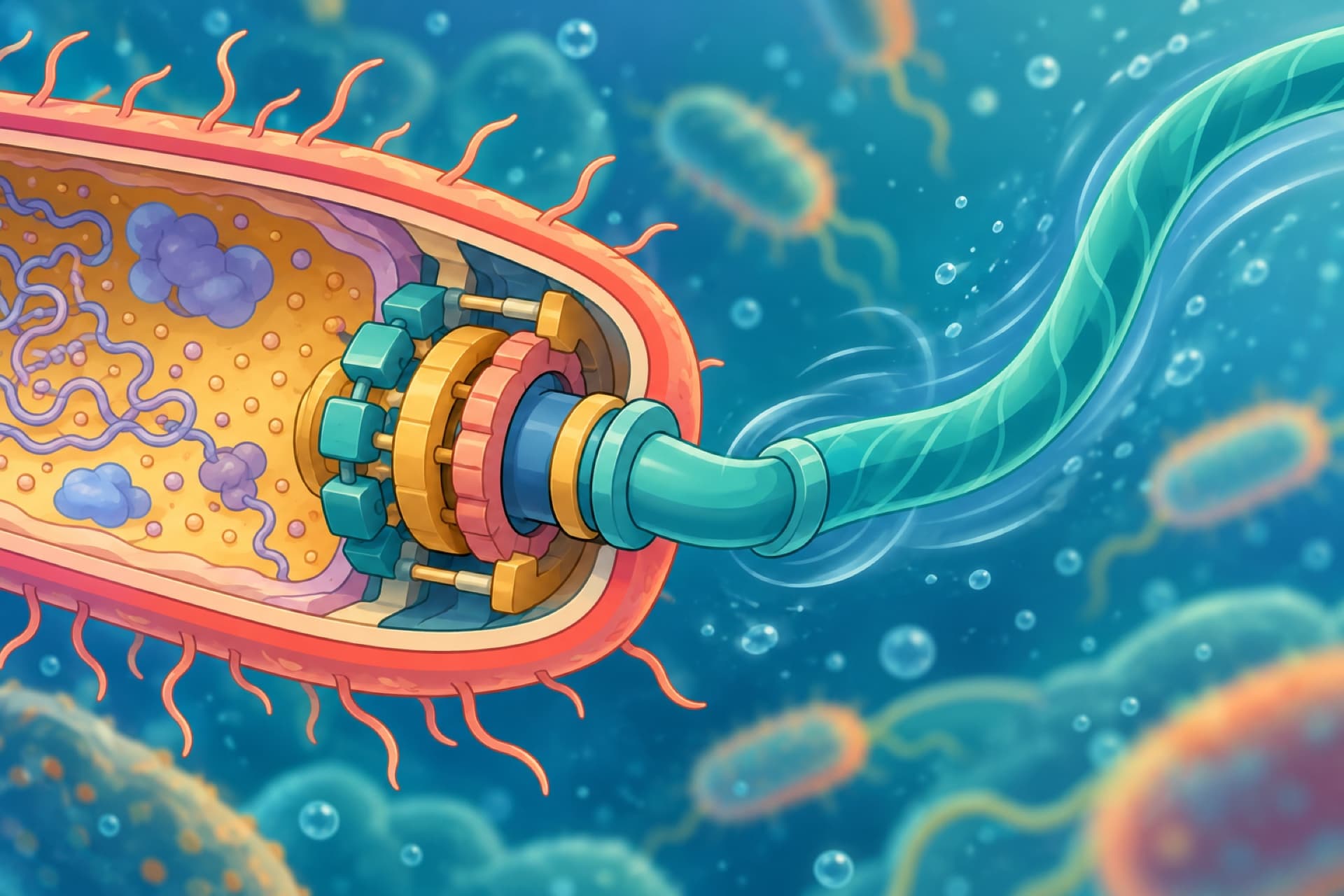
Say: This is Part 4 of five. Last time we asked if the first cell could have put itself together. Today we go inside a germ, far too small to see, and find a motor.
Say: It spins a long tail like a propeller, hundreds of times a second, and it can run in reverse. Could blind evolution have built it, one small step at a time? Charles Darwin himself told us how to test that.
Take one away
Do: Hold up the mousetrap and name its five parts: the base, the spring, the hammer, the catch, and the bar that holds the hammer back. Set it, then set it off with a pencil (never a finger). Snap!
Ask: If I take off the hammer, will it catch fewer mice? (No. It catches none.) What if I take off the spring? (None again.)
Say: Some things only work when every part is there at once. Keep this trap in mind. A scientist named Michael Behe used it to ask a big question about the machines inside your cells.
Clicks: 1. the line “Take away one part. How many mice does it catch?”
Memory verse
Do: Say it together with the motions, filling in the three missing words: “in the beginning” (point back over your shoulder), “God created” (hands up), “the heavens” (reach high), “and the earth” (touch the floor).
Say: Three parts down, and this verse is still our anchor. Today three of its words are missing. Older kids leave out three words of theirs, too.
Answers: beginning, heavens, earth.
Clicks: 1. the missing word “beginning” · 2. the missing word “heavens” · 3. the missing word “earth”
Darwin's test · Watch: Darwin's own test
Say: Here's the test Darwin himself set, and the man who looked inside the cell to try it.
Do: Read the two questions out loud, then click to play the clip. It's about 1¼ minutes and stops by itself.
Ask after: What would make Darwin's theory break down? What happens with no hammer? Click once for each answer.
Prepare: Before class, watch the video lesson this clip comes from, with every source written out: “Could evolution build the cell's machines?”
Clicks: 1. play the clip (it stops by itself) · 2. the answer to 1: A complex organ that couldn't be formed by many small steps, one after another. · 3. the answer to 2: It doesn't catch fewer mice. It catches none.
Sources: Darwin, On the Origin of Species, 6th ed. (1872), ch. 6, p. 146 · Michael Behe, Darwin's Black Box (1996)
Every part or nothing
Say: Darwin was honest about his theory. He wrote that if anyone could show a complex organ that “could not possibly have been formed by numerous, successive, slight modifications, my theory would absolutely break down.” Then he added, “But I can find out no such case.”
Say: In Darwin's day, nobody could see the machines inside a cell. In 1996, the biochemist Michael Behe looked inside, the box Darwin couldn't open. He called some of its machines “irreducibly complex”: they need several parts that fit together, and take away any one of them, and the machine stops working.
Say: Like the mousetrap. Without the hammer, Behe said, “the mouse could dance all night on the platform without becoming pinned to the wooden base.”
Ask: Why can't a trap like that be built one part at a time, if each step has to work? (A trap with only some of its parts catches nothing.)
Clicks: 1. the line “In 1996, Michael Behe said some of the cell's machines are like a mousetrap: take one part away, and they stop.”
Sources: Darwin, On the Origin of Species, 6th ed. (1872), ch. 6, p. 146 · Michael Behe, Darwin's Black Box (1996) · Irreducible complexity
The motor · Watch: A motor in a germ
Say: Now let's be clear about what's being asked, and then look closely at the motor.
Do: Read the two questions out loud, then click to play the clip. It's about 1½ minutes.
Ask after: What change does nobody doubt? What did Shapiro say? Click once for each answer.
Prepare: Before class, watch the video lesson this clip comes from, with every source written out: “Could evolution build the cell's machines?”
Clicks: 1. play the clip (it stops by itself) · 2. the answer to 1: Small change within a kind, like germs adapting to the drugs we use against them. · 3. the answer to 2: Detailed Darwinian accounts of any basic cell system, “only a variety of wishful speculations.”
Sources: Microevolution · Macroevolution · Berg, “The Rotary Motor of Bacterial Flagella,” Annual Review of Biochemistry 72 (2003) · James Shapiro, “In the Details . . . What?” National Review, Sept. 16, 1996, pp. 62–65
Small change, big question
Say: 1. Living things do change. Germs adapt to the drugs we use against them. That's small change within a kind, often called microevolution, and nobody doubts it.
Say: 2. The question is much bigger: could mutation and natural selection alone, with no one guiding them, build brand-new machines like this motor? That's macroevolution, and that's what Behe doubts.
Say: 3. The motor in a germ, the bacterial flagellum, is a real rotary motor. It's built from about twenty different kinds of parts, and it takes more than fifty proteins to put it together and make it work. Behe argues that if you take away one of its core parts, the germ doesn't swim slower. It doesn't swim at all.
Say: 4. James Shapiro, a scientist at the University of Chicago who is no friend of intelligent design, wrote in 1996 that there are “no detailed Darwinian accounts for the evolution of any fundamental biochemical or cellular system, only a variety of wishful speculations.” He disagreed with Behe's answer. But he agreed the usual account hadn't been given.
Ask: What's the difference between a germ changing and a germ building a motor? (Changing uses what's there. A motor is a whole new machine.)
Clicks: 1. step 1 · 2. step 2 · 3. step 3 · 4. step 4 · 5. the line at the bottom
Sources: Microevolution · Macroevolution · Bhattacharyya et al., PNAS (2024): “Assembly and function of bacterial flagella requires over 50 proteins” · Michael Behe, Darwin's Black Box (1996) · James Shapiro, “In the Details . . . What?” National Review, Sept. 16, 1996, pp. 62–65
The best reply · Watch: The best reply
Say: Behe's critics have a serious answer. Let's hear the best one, and Behe's reply.
Do: Read the two questions out loud, then click to play the clip. It's about 1 minute.
Ask after: What did Miller point to? What did Behe answer? Click once for each answer.
Prepare: Before class, watch the video lesson this clip comes from, with every source written out: “Could evolution build the cell's machines?”
Clicks: 1. play the clip (it stops by itself) · 2. the answer to 1: A tiny syringe some germs use to inject proteins into other cells. · 3. the answer to 2: Finding some of the parts in another machine doesn't show how either one was built.
Sources: Kenneth Miller, “The Flagellum Unspun,” in Debating Design (Cambridge, 2004), p. 87 · Pallen and Matzke, “From The Origin of Species to the origin of bacterial flagella,” Nature Reviews Microbiology (2006) · Michael Behe, The Edge of Evolution (2007)
A syringe isn't a motor
Say: Here's the best reply. The biologist Kenneth Miller pointed out that some of the proteins at the base of the motor look like the parts of a different machine: a tiny syringe some germs use to inject proteins into other cells. That syringe works without most of the motor's parts. So, Miller argued, part of the motor already has a job of its own. In 2006, two other scientists, Mark Pallen and Nicholas Matzke, sketched how the whole motor might have been pieced together from older parts.
Say: That's a real argument, and it's worth taking seriously. Here's Behe's answer: finding some of the parts in another machine doesn't show how either one was built. And a syringe isn't a motor. A list of parts that look alike isn't a path anyone has tested, one mutation at a time, with every step useful on its own.
Ask: If you found a bicycle bell on a scooter, would that tell you how the bicycle was built? (No. It only tells you they share a part.)
Clicks: 1. the line “Behe: parts that look alike aren't a path anyone has tested, one mutation at a time, with every step useful.”
Sources: Kenneth Miller, “The Flagellum Unspun,” in Debating Design (Cambridge, 2004), p. 87 · Type III secretion system · Pallen and Matzke, “From The Origin of Species to the origin of bacterial flagella,” Nature Reviews Microbiology (2006) · Michael Behe, The Edge of Evolution (2007)
Breaking parts · Watch: Breaking doors
Say: Germs do adapt, and you can watch it happen in a lab. But how do they do it?
Do: Read the two questions out loud, then click to play the clip. It's under a minute.
Ask after: How do germs keep the drug out? What's Behe's first rule? Click once for each answer.
Prepare: Before class, watch the video lesson this clip comes from, with every source written out: “Could evolution build the cell's machines?”
Clicks: 1. play the clip (it stops by itself) · 2. the answer to 1: They break the little doors in their wall that the drug slips in through. · 3. the answer to 2: “Break or blunt” a part, if losing it helps the germ survive.
Sources: Behe, “Experimental evolution, loss-of-function mutations, and ‘the first rule of adaptive evolution’,” Quarterly Review of Biology 85 (2010) · Pagès, James and Winterhalter, “The porin and the permeating antibiotic,” Nature Reviews Microbiology (2008) · Porins and antibiotic resistance
Breaking a part doesn't build a motor
Say: When Behe looked at decades of lab experiments on germs and viruses, he found the helpful changes came mostly from losing or blunting something the germ already had.
Say: Here's one way. Many germs have little doors in their wall, and some antibiotics slip in through those doors. Break the doors, and the drug stays out. The germ lives, but only by breaking something.
Ask: If you kept a robber out of your house by gluing your front door shut, would you have built a new house? (No. You'd have broken the one you had.)
Worksheet: Grades 1–2 draw a line from each thing to what happens. Grades 3–4 circle true or false. Everything is in the clips you just watched.
Worksheet answers: Grades 1–2, Every part counts: 1-C · 2-D · 3-A · 4-B
Worksheet answers: Grades 3–4, True or false?: 1. T 2. F 3. T 4. T
Clicks: 1. the line “That can help a germ survive a drug. It doesn't build a motor.”
Sources: Behe, “Experimental evolution, loss-of-function mutations, and ‘the first rule of adaptive evolution’,” Quarterly Review of Biology 85 (2010) · Pagès, James and Winterhalter, “The porin and the permeating antibiotic,” Nature Reviews Microbiology (2008)
Going deeper · Grades 3–5 · Watch: The edge of evolution
Say: So how much can mutation and selection really do? Behe looked where there are huge numbers to count: malaria.
Do: Read the two questions out loud, then click to play the clip. It's about 1 minute.
Ask after: How many mutations together? How many times in fifty years? Click once for each answer.
Say: A change that needs just one mutation turns up about once in a trillion parasites, and one sick adult can carry a trillion. But for chloroquine's two, the malaria expert Nicholas White puts the odds near one in a hundred billion billion. Behe's point: if two changes that only help together are this rare, a motor is a far bigger ask, unless every step along the way did something useful on its own. And for the motor, nobody has shown those steps.
Worksheet: Grade 5+ numbers the time line now; the dates are in their story.
Prepare: Before class, watch the video lesson this clip comes from, with every source written out: “Could evolution build the cell's machines?”
Worksheet answers: Grade 5+, Time line: 1. Darwin writes that his theory “would absolutely break down.” 2. Behe calls some of the cell's machines “irreducibly complex.” 3. Kenneth Miller points to the tiny syringe. 4. Pallen and Matzke sketch how the motor might have been pieced together. 5. Behe points to malaria and chloroquine.
Clicks: 1. play the clip (it stops by itself) · 2. the answer to 1: At least two. · 3. the answer to 2: Fewer than ten times.
Sources: Nicholas White, “Antimalarial drug resistance,” Journal of Clinical Investigation 113 (2004) · Michael Behe, The Edge of Evolution (2007) · Summers et al., “Diverse mutational pathways converge on saturable chloroquine transport via the malaria parasite's chloroquine resistance transporter,” PNAS (2014)
Quick check
Do: Read each one and have kids stand up for true and sit down for false. Click to stamp each answer.
Answers: 1. False. 2. True. 3. True. 4. False.
Clicks: 1. the answer to 1: False. It catches none. · 2. the answer to 2: True. Nobody doubts it. · 3. the answer to 3: True. · 4. the answer to 4: False. It survives by losing something it had.
Good news · Watch: Wonderfully made
Say: When you find a motor built from parts that only work together, what's the simplest answer? Let's hear it, and what the Bible says about you.
Do: Read the two questions out loud, then click to play the clip. It's under a minute.
Ask after: What did David say? What did the elders say? Click once for each answer.
Prepare: Before class, watch the video lesson this clip comes from, with every source written out: “Could evolution build the cell's machines?”
Clicks: 1. play the clip (it stops by itself) · 2. the answer to 1: “I am fearfully and wonderfully made.” · 3. the answer to 2: “You created all things.”
Sources: The watchmaker argument · Psalm 139:14 · Revelation 4:10–11
You belong to him
Say: When you find a motor, you know someone designed it. That's the answer we give for every other motor. And you're far more wonderful than a germ's motor.
Say: In a vision of heaven, John heard the elders say to God, “You are worthy, our Lord and God, to receive glory and honor and power, for you created all things, and by your will they were created and have their being.”
Say: That means you. God made you on purpose, and he knows you. If he made you, you belong to him. And he didn't leave us on our own: the rest of this course is about how he came for us in Jesus.
Ask: What would you like to say to the God who made you?
Clicks: 1. the line “God made you on purpose. If he made you, you belong to him.”
Sources: Psalm 139:14 · Revelation 4:10–11
Say it again
Do: Say the verse together, filling in the missing words. Then try it with eyes closed.
Answers: beginning, heavens, earth (the same words as the grades 1–2 sheet).
Worksheet: Everyone fills in their own memory verse on the sheet and colors a star each time they say it.
Worksheet answers: Grades 1–2, Genesis 1:1: beginning, heavens, earth
Worksheet answers: Grades 3–4, Psalm 19:1: glory, skies, hands
Worksheet answers: Grade 5+, John 1:3: things, without, nothing
Clicks: 1. the missing word “beginning” · 2. the missing word “heavens” · 3. the missing word “earth”
Talk and pray
Do: Talk about one or two of the questions, then pray together. Kids can repeat the prayer one line at a time.
Do: Send the worksheets home, with this part's one-minute Short for families. The link is in your guide, under “Send it home.”
Say: Next time, Part 5: every person you pass on the street is family. What does our DNA say about where we all came from?
Clicks: 1. the prayer
Answer key
Do: Show this when kids check their work, or keep it on your laptop in the presenter view. The worksheets don't print their answers, so this is the key.
Pictures and Scripture
Every picture on these slides, with its credit, license, and a link to its source.