
Where do right and wrong come from?
The moral law
★ Kids' lesson▶ Watch the ShortA 9-minute video All the videos on YouTube
The short answer
From God. Some things are wrong for everyone, whatever they feel or their culture says, and every quarrel shows we know it. Instinct, culture and opinion can't make a law like that. A real moral law needs a lawgiver, and he's good. The same law shows we've all broken it, and the one who wrote it came in Jesus to rescue us.
Is anything really wrong?
Not just unpopular, or against the rules. Wrong. Picking on someone who can't fight back. Betraying a friend who trusted you. You know those are wrong, even if everyone around you called them fine.
Here's the Christian answer: that “wrong” is real, it binds everyone, and it comes from the God who made us. The Bible says he wrote his law on every human heart. So where right and wrong come from tells us who's behind the universe.

Sources:The moral argumentRomans 2:14–15
Listen to a quarrel
C. S. Lewis, the Oxford scholar who had once been a convinced atheist, said you can learn something important just by listening to people quarrel. They say things like, “How'd you like it if anyone did the same to you?” “That's my seat, I was there first.” “Come on, you promised.”
Nobody says, “I just don't happen to like what you did.” They point to a standard, and they expect the other person to know it too.
That same question broke Lewis's own main argument against God. He'd argued that the universe was cruel and unjust. Then he asked himself:
“But how had I got this idea of just and unjust? A man does not call a line crooked unless he has some idea of a straight line.”
C. S. Lewis, Mere Christianity

Sources:C. S. Lewis, Mere Christianity (1952), Book 1, chapters 1–2C. S. Lewis, Mere Christianity (1952), Book 2, chapter 1
“It's just instinct”
People usually give one of four answers for where the standard comes from: instinct, culture, opinion, or a real moral law. Take them in turn.
First, instinct: we're wired to care about each other, so cruelty feels wrong. But Lewis noticed something. Hear someone shouting for help in the water, and you feel two pulls: one to help, and one to stay safe. Then a third thing tells you to follow the weaker pull, the one to help. That third thing can't be one of the instincts.
“The Moral Law tells us the tune we have to play: our instincts are merely the keys.”
C. S. Lewis, Mere Christianity
And even if instinct explains the feeling, it can't make the feeling true.

Sources:C. S. Lewis, Mere Christianity (1952), Book 1, chapters 1–2The moral argument
“It's just culture”
Second, culture: each society makes its own rules, and that's all right and wrong are. But try to picture what Lewis asked his listeners to picture, a country “where people were admired for running away in battle, or where a man felt proud of double-crossing all the people who had been kindest to him.” You can't, really. Cultures have argued about plenty, but as Lewis said, “Selfishness has never been admired.”
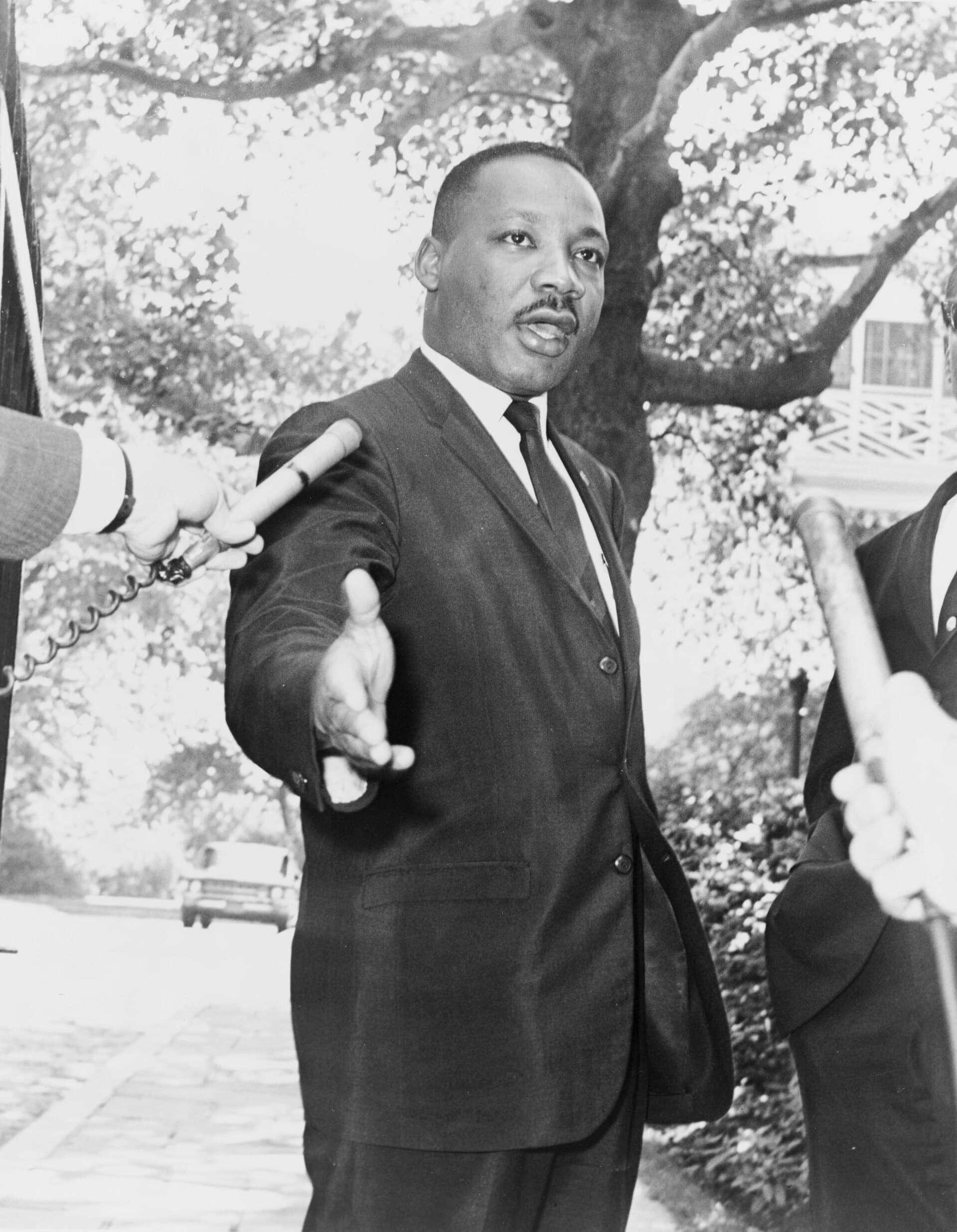
And if culture is all there is, then nobody could ever tell their own country it was wrong. But that's exactly what Martin Luther King Jr. did. Writing from a jail cell in Birmingham in 1963, he said:
“A just law is a man-made code that squares with the moral law or the law of God. An unjust law is a code that is out of harmony with the moral law.”
Martin Luther King Jr., “Letter from Birmingham Jail” (1963)
The laws of his state backed segregation. King appealed to a law above the state, and he was right.
After World War Two, Nazi leaders were tried at Nuremberg, and many of them said they had only followed orders. The court didn't accept it. The principles the United Nations drew from the trials say that acting on a government's order “does not relieve him from responsibility under international law, provided a moral choice was in fact possible to him.” The world held that there's a law above any government's orders.
Sources:C. S. Lewis, Mere Christianity (1952), Book 1, chapters 1–2Martin Luther King Jr., “Letter from Birmingham Jail” (1963)Letter from Birmingham JailPrinciples of International Law Recognized in the Charter of the Nürnberg Tribunal, Principle IV (UN International Law Commission, 1950)Superior orders
“It's just my opinion”
Third, opinion: right and wrong are whatever each of us feels. Then “cruelty is wrong” would mean no more than “I don't like broccoli.”
But when someone cheats you, you don't say you dislike it. You say it isn't fair, as if there's a standard they should have kept, and they know it too. And watch how hard we work at excuses when we break it. Nobody makes excuses for not liking broccoli.
That leaves the fourth answer: there's a real moral law. Then “wrong” means what it says, for everyone, whether they agree or not.

Sources:C. S. Lewis, Mere Christianity (1952), Book 1, chapters 1–2The moral argument
A law needs a lawgiver
Even one of the best-known atheist philosophers of the last century saw where a real moral law leads. J. L. Mackie taught philosophy at Oxford. He opened the first chapter of his book on ethics with this: “There are no objective values.” Years later, in a book weighing the arguments for God, he granted what it would mean if they were real. They would be:
- If there's no God, there's no real moral law, only feelings and customs. Mackie saw that.
- But there is a real moral law. You know it every time you say, “That isn't fair.”
- So there is a lawgiver. And he's good, because the law he wrote on our hearts is good.
“so odd a cluster of qualities and relations that they are most unlikely to have arisen in the ordinary course of events, without an all-powerful god to create them.”
J. L. Mackie, The Miracle of Theism (1982)
So Mackie agreed with Christians on the hard part: a real moral law would point to God. He just denied the law was real. Think it through:
Some atheists answer that moral facts just exist, with no one behind them. But a law that commands you, with nobody doing the commanding, is the very oddness Mackie couldn't accept.

Sources:J. L. Mackie, Ethics: Inventing Right and Wrong (1977), p. 15J. L. Mackie, The Miracle of Theism (1982), pp. 115–116The moral argument
Is good just whatever God says?
There's a fair question that goes all the way back to Plato. In his dialogue the Euthyphro, Socrates asks “whether the pious or holy is beloved by the gods because it is holy, or holy because it is beloved of the gods.” Put it for one God. Is something good because God commands it? Then good could be anything. Or does God command it because it's good? Then good is something above God.
The Christian answer is that good comes from God's own character. His commands aren't random, because they come from who he is, and there's nothing above him to measure him by. That's why he tells his people:
“Be holy because I, the Lord your God, am holy.”
Leviticus 19:2
And John sums it up in three words: “God is love” (1 John 4:8).

Sources:Plato, Euthyphro, tr. Benjamin Jowett (Project Gutenberg)The Euthyphro dilemmaLeviticus 19:21 John 4:8
Can atheists be good?
Someone might ask, “So are you saying atheists can't be good?” Not at all. Plenty of atheists are kind, honest, and brave. Paul expected that. He wrote that people without the Bible's law still “do by nature things required by the law.”
“They show that the requirements of the law are written on their hearts.”
Romans 2:15
So everyone can know the law. The question is who wrote it.

Sources:Romans 2:14–15
Putting it together
Put the moral law together with the clues of Chapter 1:
- A universe that had a beginning.
- Dials set just right for life.
- A code written inside every cell, and machines no blind process has been shown to build.
- And a law written on every heart.
Someone is there: someone with the power to make it all, the mind to design it, and the goodness to tell right from wrong.

Sources:The cosmological argumentFine-tuned universeThe origin of life (abiogenesis)Michael Behe, Darwin's Black Box (1996)The moral argument
The law we break
But the law on your heart has a harder side. Lewis ended his first chapter with two facts about all of us:
“First, that human beings, all over the earth, have this curious idea that they ought to behave in a certain way, and cannot really get rid of it. Secondly, that they do not in fact behave in that way.”
C. S. Lewis, Mere Christianity
We know the law, and we break it. The Bible says it plainly: “all have sinned and fall short of the glory of God” (Romans 3:23). So the law on your heart points two ways. It points up, to a good God who wrote it. And it points at you, because you've broken it.

Sources:C. S. Lewis, Mere Christianity (1952), Book 1, chapters 1–2Romans 3:23
Check yourself
What did C. S. Lewis notice about the way people quarrel?Show the answer
Nobody says, “I just don't happen to like what you did.” They point to a standard, like “I was there first” or “You promised,” and expect the other person to know it too.
Why can't instinct be the moral law?Show the answer
When two instincts pull against each other, like helping someone in the water or staying safe, a third thing tells you which one to follow, often the weaker one. That third thing can't be one of the instincts. And explaining a feeling doesn't make it true.
How do King's letter and the Nuremberg trials answer “it's just culture”?Show the answer
King told his own state its segregation laws were unjust, appealing to “the moral law or the law of God.” At Nuremberg, “I was following orders” was no defense where a moral choice was possible. Both appeal to a law above any society.
What did the atheist J. L. Mackie grant about objective moral values?Show the answer
That if they were real, they would be “so odd” that they are most unlikely to have arisen “without an all-powerful god to create them.” He agreed a real moral law would point to God. He denied the law was real.
How does the Christian answer Plato's Euthyphro question?Show the answer
Good isn't something God makes up, and it isn't a standard above him. It comes from his own character: “Be holy because I, the Lord your God, am holy,” and “God is love.”
What two facts about all of us did Lewis end his first chapter with?Show the answer
Everyone, all over the earth, has the idea that we ought to behave a certain way and can't get rid of it. And we don't in fact behave that way. We know the law, and we break it.
The one who wrote it came
Here's the best news in the world: the one who wrote the law came to rescue the people who broke it. Jesus said he came “to give his life as a ransom for many” (Mark 10:45). And Paul wrote that God “forgave us all our sins, having canceled the charge of our legal indebtedness, which stood against us and condemned us; he has taken it away, nailing it to the cross” (Colossians 2:13–14).
Three days later Jesus rose, beating death itself. The one who wrote the law is alive, and he's calling you.
So don't run from the law on your heart. Let it bring you to him.
“If we confess our sins, he is faithful and just and will forgive us our sins and purify us from all unrighteousness.”
1 John 1:9
You could pray: God, I know I've broken your law. Thank you that Jesus gave his life to set me free. Forgive me, and make me yours. I will follow you.

Sources:Mark 10:45Colossians 2:13–141 Corinthians 15:3–4Hebrews 2:14–151 John 1:9