Chapter 2, Part 3: Did the feasts point to Jesus?
The promises · Lesson 3 of 3 · About 28 minutes · Grades 1–5
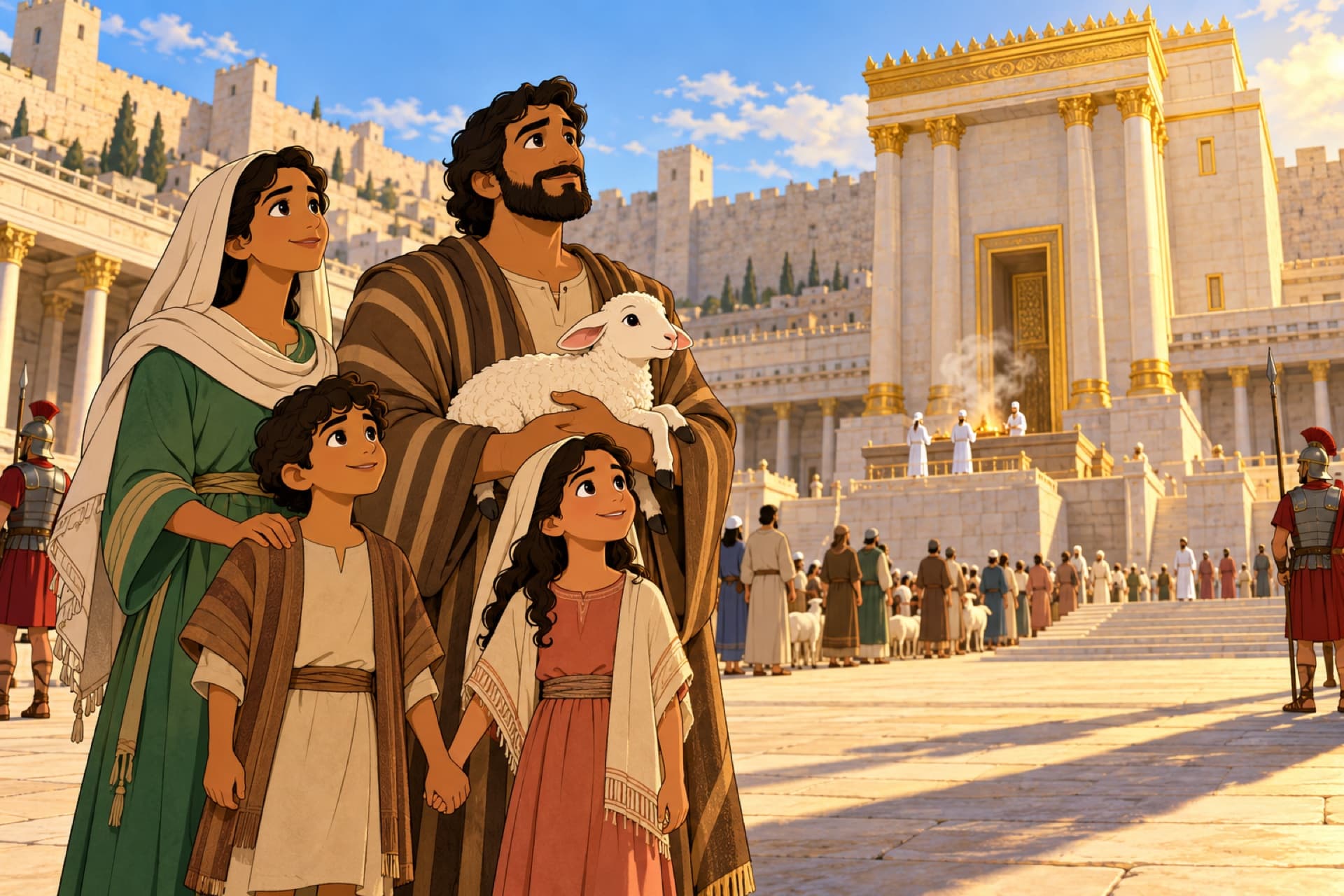
 The Evidence for Jesus · A lesson for grades 1–5
The promises
Big questionDid the feasts point to Jesus?
By the end, kids can
- Tell how Jesus died at Passover, at the hour the lambs were killed, and why Paul calls him “our Passover lamb.”
- Match the four spring feasts to four events, each on its day: the lamb, the burial, the resurrection, and the Spirit.
- Name more shadows that pointed to Jesus: the lamb God provided on Moriah, the bronze snake, and Jonah.
- Say the memory verse from memory: Joshua 21:45 (grades 3–4: Isaiah 53:5; grade 5+: 2 Corinthians 1:20).
You'll need
- This part's one-page worksheet for each child's level (grades 1–2, 3–4, or 5), handed out at the start
- Pencils
- A screen with sound and internet: the clips come from the video “Jesus in the Feasts”
Before you teach
This lesson plays one of the chapter's video lessons in clips. Its page makes the same case for teens and adults, with every source written out: watch it to prepare, or use it with older kids and youth groups. Click a part to go to its slide:
- Did Israel's feasts point to Jesus? Passover, Firstfruits, Pentecost · In class: Passover, Passover, The spring feasts, The spring feasts, More shadows, Going deeper · Grades 3–5, Good news
The lesson
- 2 min Warm-up: coincidence?
- 2 min Memory verse: fill in the missing words
- 6 min Passover: watch two short clips (1½ minutes), then talk
- 6 min The spring feasts: watch two clips (2 minutes), four in a row, and the worksheet
- 3 min More shadows: watch (1½ minutes), then talk
- 3 min Going deeper (grades 3–5): the fall feasts, the hope (1½ minutes)
- 1 min A quick check
- 2 min Good news: watch (half a minute), then set free
- 3 min Memory verse from memory, talk, and pray
Worksheets
Print this lesson's one-page sheet for each child, at their level. They fill it in as you go: the ✎ Worksheet sticker on a slide says which part goes with it.
Send it home
After class, share the one-minute Short with families, to watch together and talk about this week:
Answer key
The worksheets don't print their answers. Here they all are, and on the slide before the credits.
Grades 1–2
- True or false? 1. T 2. T 3. F 4. T
- Joshua 21:45: good, promises, fulfilled
Grades 3–4
- Four feasts, four events: 1-C · 2-D · 3-A · 4-B
- Isaiah 53:5: punishment, peace, wounds, healed
Grade 5+
- Think it through: Answers will vary. Look for: 1. Passover: he died; Unleavened Bread: he lay in the tomb; Firstfruits: he rose; Pentecost: the Spirit came · 2. they couldn't set a Roman execution, the empty tomb, or the Spirit's coming · 3. the rest of the harvest is coming: his people will rise too · 4. he said he must be lifted up the same way, so those who look to him live
- 2 Corinthians 1:20: promises, Yes, Christ
Presenting
Each part opens with a ▶ Watch slide that plays a clip of the 7-minute video “Jesus in the Feasts: Passover, Firstfruits, Pentecost, and the Shadows That Point to Him” right on the slide: read the two questions, then click (or press →, or use a clicker) to play the clip. The slides wait while it plays and stops by itself; click twice to stop it early. Then click to show the answers. The clips need an internet connection.
Click the slide, or press → or Space (a clicker works too), to show the next thing; ← goes back, even while a clip plays. F presents full screen (Esc leaves it). P opens the presenter view, a second window with your notes, the next slide, and a timer, that moves with the slides: put it on your laptop and the slides on the projector. N shows the notes under the slides.
Your script
The promises
Say: Last time we ran Daniel's countdown, and saw that Jesus came right on time. Today is Part 3, the last part of this chapter: the feasts.
Say: Jesus died at Passover, in the afternoon, at the hour the Passover lambs were being killed. Coincidence?
Coincidence?
Ask: What do we remember at Christmas? At Easter? On the Fourth of July? (Let kids answer.)
Say: Centuries before Jesus, God gave Israel a calendar of holy days, called feasts. Paul called them “a shadow of the things that were to come; the reality, however, is found in Christ.”
Ask: What does a shadow show you? (The shape of something real that's coming.)
Clicks: 1. the line “God gave Israel seven feasts. The biggest days of Jesus's life landed on them, on dates his followers didn't choose.”
Sources: Leviticus 23 · Colossians 2:16–17
Remember our verse?
Do: Say it together once with the motions. Then click to show each missing word as kids call it out. There are more blanks this time.
Answers: good, promises, fulfilled (the same words as the grades 1–2 sheet).
Clicks: 1. the missing word “good” · 2. the missing word “promises” · 3. the missing word “fulfilled”
Passover · Watch: The first Passover
Say: Leviticus lists seven feasts, four in the spring and three in the fall. The first is Passover.
Do: Read the two questions out loud, then click to play the clip. It's under a minute and stops by itself.
Ask after: What did they paint on the door? What did God say? Click once for each answer.
Prepare: Before class, watch the video lesson this clip comes from, with every source written out: “Did Israel's feasts point to Jesus?”
Clicks: 1. play the clip (it stops by itself) · 2. the answer to 1: The blood of a lamb “without defect.” · 3. the answer to 2: “I will pass over you.” And they walked out free.
Sources: Colossians 2:16–17 · Leviticus 23:4–43 · Exodus 12:5–14
Passover · Watch: The hour of the lambs
Say: Now watch what happened at the Passover when Jesus died.
Do: Read the two questions out loud, then click to play the clip. It's under a minute.
Ask after: When did Jesus die? What about the bones? Click once for each answer.
Prepare: Before class, watch the video lesson this clip comes from, with every source written out: “Did Israel's feasts point to Jesus?”
Clicks: 1. play the clip (it stops by itself) · 2. the answer to 1: About three in the afternoon, the hour the lambs were killed. · 3. the answer to 2: “Do not break any of the bones.” None of Jesus's were broken.
Sources: Mark 14:1–2 · John 19:14, 31–36 · Mark 15:33–37 · Josephus, Jewish War 6.9.3 (6.423), tr. Whiston · Exodus 12:46
Our Passover lamb
Say: The chief priests said, “But not during the festival, or the people may riot.” They didn't plan for Passover. It happened anyway.
Say: John says it was “the day of Preparation of the Passover.” Mark says Jesus cried out “at three in the afternoon.” And the Jewish historian Josephus records that the lambs were killed “from the ninth hour till the eleventh,” from three o'clock on.
Say: The Law said of the Passover lamb, “Do not break any of the bones.” And John says of Jesus, “Not one of his bones will be broken.”
Clicks: 1. the line ““Christ, our Passover lamb, has been sacrificed.” 1 Corinthians 5:7”
Sources: Mark 14:1–2 · John 19:14 · Mark 15:33–37 · Josephus, Jewish War 6.9.3 (6.423), tr. Whiston · Exodus 12:46 · John 19:31–36 · 1 Corinthians 5:7
The spring feasts · Watch: Buried, and raised
Say: Two more feasts came right after Passover: Unleavened Bread and Firstfruits.
Do: Read the two questions out loud, then click to play the clip. It's under a minute.
Ask after: What was yeast a picture of? What day did Jesus rise? Click once for each answer.
Prepare: Before class, watch the video lesson this clip comes from, with every source written out: “Did Israel's feasts point to Jesus?”
Clicks: 1. play the clip (it stops by itself) · 2. the answer to 1: Sin, working through the whole batch of dough. · 3. the answer to 2: The day after the Sabbath: Firstfruits.
Sources: Leviticus 23:6, 10–11 · 1 Corinthians 5:6–8 · Acts 2:27 · Mark 16:1–6 · 1 Corinthians 15:20
The spring feasts · Watch: Pentecost, and four in a row
Do: Read the two questions out loud, then click to play the clip. It's about 1 minute.
Ask after: How many were added? What couldn't they have set? Click once for each answer.
Prepare: Before class, watch the video lesson this clip comes from, with every source written out: “Did Israel's feasts point to Jesus?”
Clicks: 1. play the clip (it stops by itself) · 2. the answer to 1: About three thousand. · 3. the answer to 2: The hour of a Roman execution, the morning the tomb was found empty, or the day the Spirit came.
Sources: Leviticus 23:15–16 · Talmud, Pesachim 68b, William Davidson translation (Sefaria) · Exodus 32:28 · Acts 2:1–41 · Mark 15:1–15
Four in a row
Say: Four spring feasts, four events, in order, each on its day. Click for each one.
Say: At Sinai, when the people worshiped a golden calf, “about three thousand of the people died.” On the Pentecost after the resurrection, “about three thousand were added to their number that day.” Paul put it this way: “The letter kills, but the Spirit gives life.”
Ask: Could his followers have staged it? (They could bring him to Jerusalem for Passover. They couldn't set the hour of a Roman execution, the morning the tomb was found empty, or the day the Spirit came.)
Worksheet: Grades 1–2 circle T or F now. Grades 3–4 draw a line from each feast to what happened on it.
Worksheet answers: Grades 1–2, True or false?: 1. T 2. T 3. F 4. T
Worksheet answers: Grades 3–4, Four feasts, four events: 1-C · 2-D · 3-A · 4-B
Clicks: 1. the card “Passover” · 2. the card “Unleavened Bread” · 3. the card “Firstfruits” · 4. the card “Pentecost” · 5. the line at the bottom
Sources: Leviticus 23:4–16 · John 19:14, 31 · Mark 16:1–2 · Acts 2:1–4 · 2 Corinthians 3:6
More shadows · Watch: A lamb, a snake, and Jonah
Say: The feasts aren't the only shadows. Here are three more, from long before Jesus.
Do: Read the two questions out loud, then click to play the clip. It's about 1½ minutes.
Ask after: What did Abraham say? What sign did Jesus name? Click once for each answer.
Prepare: Before class, watch the video lesson this clip comes from, with every source written out: “Did Israel's feasts point to Jesus?”
Clicks: 1. play the clip (it stops by itself) · 2. the answer to 1: “God himself will provide the lamb.” · 3. the answer to 2: Jonah: three days and three nights.
Sources: Genesis 22:1–14 · 2 Chronicles 3:1 · Numbers 21:4–9 · John 3:14–15 · Matthew 12:38–40 · Luke 24:25–27
All pointing at him
Say: On Mount Moriah, God stopped Abraham's hand and gave a ram instead. Centuries later, the Temple was built in Jerusalem “on Mount Moriah.”
Say: When snakes bit the people in the wilderness, “anyone who is bitten can look at it and live.” Jesus said he would be lifted up the same way. And he told them ahead of time about Jonah's three days.
Ask: Which shadow do you think points to Jesus most clearly? Why?
Worksheet: Grade 5+ answers the questions on their sheet now.
Worksheet answers: Grade 5+, Think it through: Answers will vary. Look for: 1. Passover: he died; Unleavened Bread: he lay in the tomb; Firstfruits: he rose; Pentecost: the Spirit came · 2. they couldn't set a Roman execution, the empty tomb, or the Spirit's coming · 3. the rest of the harvest is coming: his people will rise too · 4. he said he must be lifted up the same way, so those who look to him live
Clicks: 1. the line “The feasts, the lamb, the mountain, the pole: after he rose, Jesus explained “what was said in all the Scriptures concerning himself.””
Sources: Genesis 22:8–14 · 2 Chronicles 3:1 · Numbers 21:8–9 · John 3:14–15 · Luke 24:25–27
Going deeper · Grades 3–5 · Watch: The fall feasts: the hope
Say: The three fall feasts haven't been filled the same way yet. Christians have long seen in them the hope of his return.
Do: Read the two questions out loud, then click to play the clip. It's about 1½ minutes.
Ask after: How will the Lord come? What does “made his dwelling” mean? Click once for each answer.
Say: Trumpets: Jesus will send his angels “with a loud trumpet call.” The Day of Atonement: the high priest went behind the curtain with blood, and Jesus “entered heaven itself, now to appear for us in God's presence.” Tabernacles: God will live with his people. The Bible ends with this promise: “God's dwelling place is now among the people, and he will dwell with them.”
Prepare: Before class, watch the video lesson this clip comes from, with every source written out: “Did Israel's feasts point to Jesus?”
Clicks: 1. play the clip (it stops by itself) · 2. the answer to 1: “With the trumpet call of God.” · 3. the answer to 2: He pitched his tent with us, like the shelters at Tabernacles.
Sources: Leviticus 23:23–43 · Matthew 24:30–31 · 1 Thessalonians 4:16–17 · Hebrews 9:24, 28 · John 1:14 · Revelation 21:3
True or false?
Do: Read each one and have kids stand up for true and sit down for false. Click to stamp each answer.
Answers: 1. True. 2. False. 3. True. 4. False.
Clicks: 1. the answer to 1: True. At the hour the lambs were killed. · 2. the answer to 2: False. A Roman governor gave the order. · 3. the answer to 3: True. · 4. the answer to 4: False. Not one of his bones was broken.
Good news · Watch: Your Passover lamb
Do: Read the two questions out loud, then click to play the clip. It's half a minute.
Ask after: What did the blood mean? What did Jesus give his life to do? Click once for each answer.
Prepare: Before class, watch the video lesson this clip comes from, with every source written out: “Did Israel's feasts point to Jesus?”
Clicks: 1. play the clip (it stops by itself) · 2. the answer to 1: Death passed over, and the family walked out free. · 3. the answer to 2: To be a ransom, to set you free from sin and death, for good.
Sources: Exodus 12:13 · Mark 10:45 · 1 Peter 1:18–19
Set free
Say: Peter wrote that we were redeemed “not with perishable things such as silver or gold,” but “with the precious blood of Christ, a lamb without blemish or defect.”
Say: You could pray, “Lord Jesus, you are my Passover lamb. You died and rose to set me free. I turn from my sin. I trust you, and I will follow you.”
Ask: What does Jesus set us free from? What does he set us free for? (From sin and death, to belong to him and follow him.)
Clicks: 1. the line “Jesus is our Passover lamb. He gave his life as a ransom to set us free from sin and death, and he rose again.”
Sources: Exodus 12:13 · Mark 10:45 · 1 Corinthians 5:7 · 1 Peter 1:18–19
Say it from memory
Do: Hide the words if you can (or have kids close their eyes), and say the verse together from memory with the motions.
Say: Isaiah's poem, Daniel's clock, and the feasts: God kept every one of these promises in Jesus.
Worksheet: Everyone fills in the missing words in their memory verse and colors the last star.
Worksheet answers: Grades 1–2, Joshua 21:45: good, promises, fulfilled
Worksheet answers: Grades 3–4, Isaiah 53:5: punishment, peace, wounds, healed
Worksheet answers: Grade 5+, 2 Corinthians 1:20: promises, Yes, Christ
Talk and pray
Do: Talk about one or two of the questions, then pray together. Kids can repeat the prayer one line at a time.
Say: Next chapter: if these promises came true in one man, was he a real man in history? What even skeptical historians admit.
Do: Send the worksheets home, with this part's one-minute Short for families. The link is in your guide, under “Send it home.”
Clicks: 1. the prayer
Answer key
Do: Show this when kids check their work, or keep it on your laptop in the presenter view. The worksheets don't print their answers, so this is the key.
Pictures and Scripture
Every picture on these slides, with its credit, license, and a link to its source.