Chapter 3, Part 1: Did Jesus really exist?
A real man · Lesson 1 of 3 · About 28 minutes · Grades 1–5
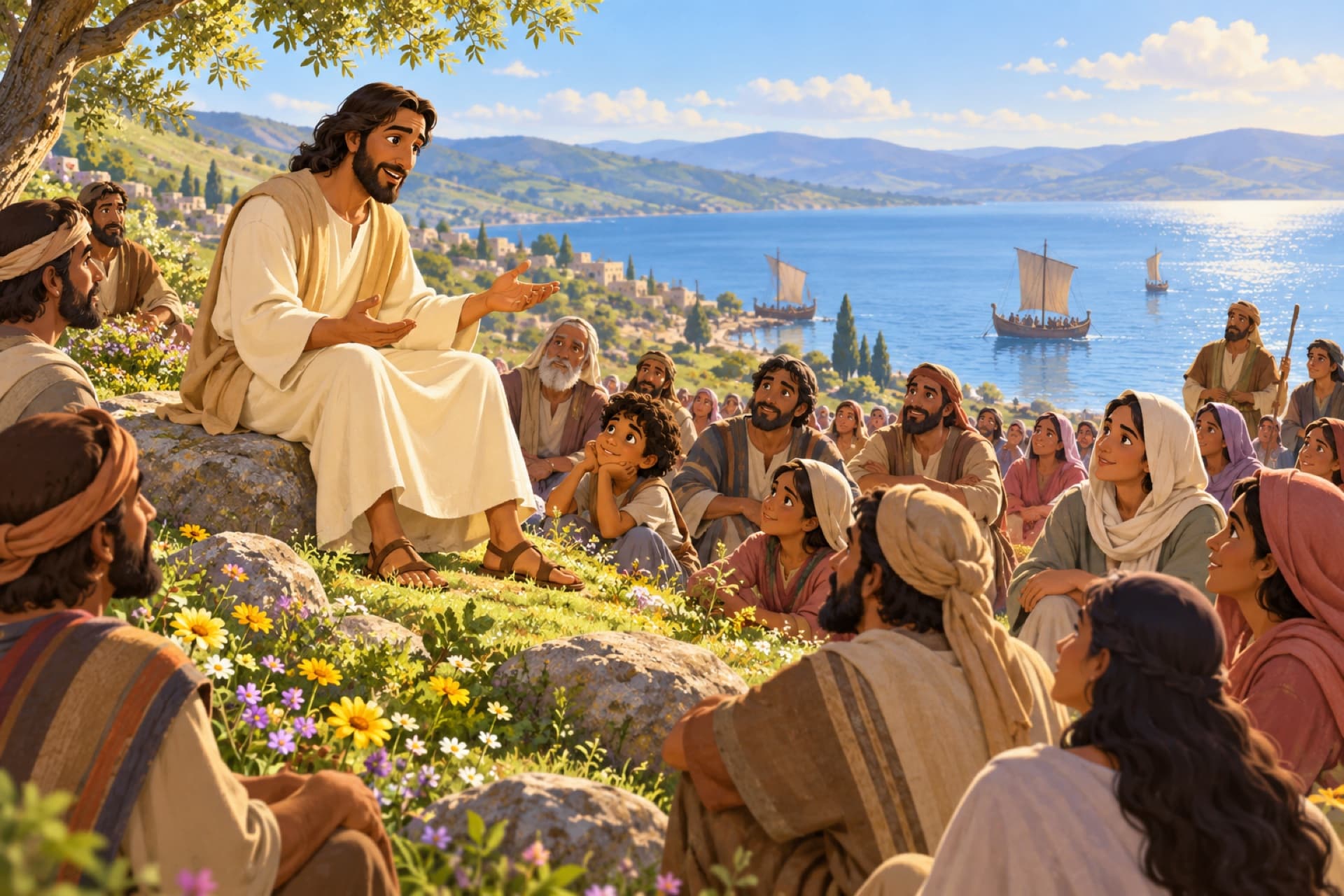
 The Evidence for Jesus · A lesson for grades 1–5
A real man
Big questionDid Jesus really exist?
By the end, kids can
- Say what nearly every historian agrees about Jesus: he lived, he gathered followers, and the Romans crucified him under Pontius Pilate.
- Name writers who weren't Christians but wrote about Jesus: Tacitus and Josephus.
- Know why his first followers prayed to him: they said he died for our sins and rose again.
- Start learning the memory verse: John 1:14 (grades 3–4: John 20:31; grade 5+: Mark 8:29).
You'll need
- This part's one-page worksheet for each child's level (grades 1–2, 3–4, or 5), handed out at the start
- Pencils
- A screen with sound and internet: the clips come from the video “Did Jesus Really Exist?”
Before you teach
This lesson plays one of the chapter's video lessons in clips. Its page makes the same case for teens and adults, with every source written out: watch it to prepare, or use it with older kids and youth groups. Click a part to go to its slide:
- Did Jesus really exist? Evidence outside the Bible · In class: Historians agree, Outside the church, Going deeper · Grades 3–5, Good news
The lesson
- 2 min Warm-up: how do we know?
- 2 min Memory verse
- 3 min What historians agree on: watch (1 minute), then talk
- 8 min Writers who weren't fans: watch (2 minutes), talk, and the worksheet
- 2 min Going deeper (grades 3–5): “Christians made it up” (half a minute)
- 4 min What even skeptics admit, and a quick check
- 4 min Good news: watch (half a minute), then why it was written
- 3 min Memory verse again, talk, and pray
Worksheets
Print this lesson's one-page sheet for each child, at their level. They fill it in as you go: the ✎ Worksheet sticker on a slide says which part goes with it.
Send it home
After class, share the one-minute Short with families, to watch together and talk about this week:
Answer key
The worksheets don't print their answers. Here they all are, and on the slide before the credits.
Grades 1–2
- True or false? 1. T 2. F 3. T 4. F
Grades 3–4
- Who wrote it? 1-B · 2-D · 3-A · 4-C
Grade 5+
- Time line: 1. The Romans crucify Jesus. 2. Paul writes letters we still have. 3. Josephus writes about Jesus. 4. Pliny writes to the emperor about Christians. 5. Tacitus writes about Christus.
Presenting
Each part opens with a ▶ Watch slide that plays a clip of the 5-minute video “Did Jesus Really Exist? Evidence Outside the Bible (Tacitus, Josephus)” right on the slide: read the two questions, then click (or press →, or use a clicker) to play the clip. The slides wait while it plays and stops by itself; click twice to stop it early. Then click to show the answers. The clips need an internet connection.
Click the slide, or press → or Space (a clicker works too), to show the next thing; ← goes back, even while a clip plays. F presents full screen (Esc leaves it). P opens the presenter view, a second window with your notes, the next slide, and a timer, that moves with the slides: put it on your laptop and the slides on the projector. N shows the notes under the slides.
Your script
A real man
Say: Last time we saw promises written long before Jesus come true in one man. This chapter asks: was that man real? And if he was, who was he?
Say: We'll take it in three parts, one short video each. Today is Part 1: did Jesus really exist? We'll test him the way historians test anyone from the ancient world.
How do we know?
Ask: How can we know someone from long ago was real? (Things they wrote, things other people wrote about them, things dug out of the ground.)
Say: Nobody doubts Alexander lived. Keep him in mind: the video is about to compare him with Jesus.
Clicks: 1. the line “So how do we know he was real? Historians test the evidence. Today we'll test Jesus the same way.”
Sources: The oldest histories of Alexander
Memory verse
Do: Read it together three times. Then add motions: “the Word” (open your hands like a book), “became flesh” (pat your arms), “made his dwelling” (make a roof over your head), “among us” (point around the room).
Say: John calls Jesus “the Word.” This verse says God came to live among us as a real man, in a real place, at a real time. We'll say it in all three parts of this chapter, so by Part 3 you'll know it.
Older kids: Grades 3–4 learn John 20:31 and grade 5+ learns Mark 8:29. They're on their worksheets.
Historians agree · Watch: What historians agree on
Say: First test: what do the experts say? Let's hear from historians, including ones who aren't Christians.
Do: Read the two questions out loud, then click to play the clip. It's under a minute and stops by itself.
Ask after: What do nearly all historians agree on? How long did Alexander have to wait? Click once for each answer.
Prepare: Before class, watch the video lesson this clip comes from, with every source written out: “Did Jesus really exist?”
Clicks: 1. play the clip (it stops by itself) · 2. the answer to 1: He lived, he gathered followers, and the Romans crucified him under Pontius Pilate. · 3. the answer to 2: About 300 years.
Sources: Historicity of Jesus · Galatians 1:18–19 · The oldest histories of Alexander
The paper trail starts early
Say: Bart Ehrman, an agnostic scholar who argues with Christians for a living, says Jesus “certainly existed, as virtually every competent scholar of antiquity, Christian or non-Christian, agrees.”
Say: And the writing starts fast. Paul's letters come within about twenty years of the cross, from a man who had stayed with Peter and met Jesus's own brother. For Alexander, it was about 300 years.
Ask: Why does it help that Paul knew Peter and James? (They had known Jesus himself.)
Clicks: 1. the line “Paul had stayed with Peter, and he met “James, the Lord's brother.””
Sources: Historicity of Jesus · Galatians 1:18–19
Outside the church · Watch: Writers who weren't fans
Say: Second test: did anyone outside the church write about him? Watch for writers who had no reason to make Jesus up.
Do: Read the two questions out loud, then click to play the clip. It's about 2 minutes.
Ask after: What did Tacitus think of Christians? Who wrote about Jesus without being a Christian? Click once for each answer.
Prepare: Before class, watch the video lesson this clip comes from, with every source written out: “Did Jesus really exist?”
Clicks: 1. play the clip (it stops by itself) · 2. the answer to 1: He couldn't stand them. He called it “a most mischievous superstition.” · 3. the answer to 2: Tacitus, a Roman senator, or Josephus.
Sources: Tacitus on Jesus · Josephus on Jesus · Pliny the Younger on Christians · Acts 18:2
Writers who weren't fans
Say: Josephus wrote around AD 93, and Tacitus around AD 116. Around AD 112 a Roman governor named Pliny wrote to the emperor about Christians who prayed to Christ “as to a divinity.”
Ask: Why does it help that people who weren't Christians wrote about Jesus? (They had no reason to make him up. Tacitus didn't even like Christians.)
Worksheet: Grades 1–2 circle T or F now. Grades 3–4 match each writer to who he was. Grade 5+ numbers the time line; the dates are in their story.
Worksheet answers: Grades 1–2, True or false?: 1. T 2. F 3. T 4. F
Worksheet answers: Grades 3–4, Who wrote it?: 1-B · 2-D · 3-A · 4-C
Worksheet answers: Grade 5+, Time line: 1. The Romans crucify Jesus. 2. Paul writes letters we still have. 3. Josephus writes about Jesus. 4. Pliny writes to the emperor about Christians. 5. Tacitus writes about Christus.
Clicks: 1. the line “Josephus, a Jewish historian, wrote about Jesus and “the brother of Jesus, who was called Christ.””
Sources: Tacitus, Annals 15.44 · Josephus, Antiquities 18.63–64 · 20.200 (Whiston) · Pliny, Letters 10.96
Going deeper · Grades 3–5 · Watch: “Christians made it up”
Say: Some people say Christians forged these lines later. Let's test that.
Do: Read the two questions out loud, then click to play the clip. It's half a minute.
Ask after: Why wouldn't a forger write that? Why don't more Romans mention him? Click once for each answer.
Say: Christian copyists did add a few words to Josephus, like “He was the Christ.” Most scholars, Christian or not, still think the core of the passage is his own. And his line about James is one no forger would bother to hide in a story about a high priest.
Prepare: Before class, watch the video lesson this clip comes from, with every source written out: “Did Jesus really exist?”
Clicks: 1. play the clip (it stops by itself) · 2. the answer to 1: No Christian would call his faith “a most mischievous superstition.” · 3. the answer to 2: They wrote about emperors, until his followers reached Rome.
Sources: Josephus on Jesus · Tacitus on Jesus
What even skeptics admit
Say: Put together what even skeptical historians admit. He lived, in the first century. He taught and gathered followers. Pilate had him crucified. And within a lifetime, his followers were praying to him as God, from Judea all the way to Rome.
Ask: That last one is strange. Why would anyone pray to a man Rome had crucified? (Hold that question. The next clip answers it.)
Clicks: 1. the card “He lived” · 2. the card “He taught” · 3. the card “He was crucified” · 4. the card “He was worshiped” · 5. the line at the bottom
Sources: Historicity of Jesus · Pliny, Letters 10.96
True or false?
Do: Read each one and have kids stand up for true and sit down for false. Click to stamp each answer.
Answers: 1. True. 2. False, Tacitus and Josephus did too. 3. False. 4. True.
Clicks: 1. the answer to 1: True. · 2. the answer to 2: False. Tacitus and Josephus wrote about him too. · 3. the answer to 3: False. He couldn't stand them. · 4. the answer to 4: True.
Good news · Watch: Why pray to a crucified man?
Say: So why would anyone pray to a man Rome had crucified? His first followers told us.
Do: Read the two questions out loud, then click to play the clip. It's half a minute.
Ask after: Why did Jesus die, his followers said? Why did John write? Click once for each answer.
Prepare: Before class, watch the video lesson this clip comes from, with every source written out: “Did Jesus really exist?”
Clicks: 1. play the clip (it stops by itself) · 2. the answer to 1: “Christ died for our sins… he was raised on the third day.” · 3. the answer to 2: That you may believe Jesus is the Son of God, and have life in his name.
Sources: 1 Corinthians 15:3–4 · John 20:30–31
Why it was written
Say: Historians can tell us Jesus lived and died. His first followers told us why: he died for our sins, and on the third day he was raised. That's why they prayed to him.
Say: John didn't write just to give us history. He wrote so that you would believe Jesus is the Son of God, and have life in his name. Jesus isn't a fairy tale. He's a real person you can know, and he wants you to follow him.
Say: The best way to meet him is to read about him. Mark is the shortest Gospel: about an hour. Read some this week.
Ask: When could you read some of Mark this week?
Clicks: 1. the line “John wrote it all down “that you may believe that Jesus is the Messiah, the Son of God, and that by believing you may have life in his name.””
Sources: 1 Corinthians 15:3–4 · John 20:30–31
Say it again
Do: Say the verse together with the motions, then try it with eyes closed.
Worksheet: Everyone reads their own memory verse at the bottom of the sheet and colors a star each time they say it. Next time we'll fill in its missing words.
Talk and pray
Do: Talk about one or two of the questions, then pray together. Kids can repeat the prayer one line at a time.
Say: Next time, Part 2: did the Gospel writers get the details right? We go digging.
Do: Send the worksheets home, and share this part's one-minute Short with families. The link is in your guide, under “Send it home.”
Clicks: 1. the prayer
Answer key
Do: Show this when kids check their work, or keep it on your laptop in the presenter view. The worksheets don't print their answers, so this is the key.
Pictures and Scripture
Every picture on these slides, with its credit, license, and a link to its source.