Chapter 3: A real man
Was Jesus a real person? · About 45 minutes · Grades 1–5
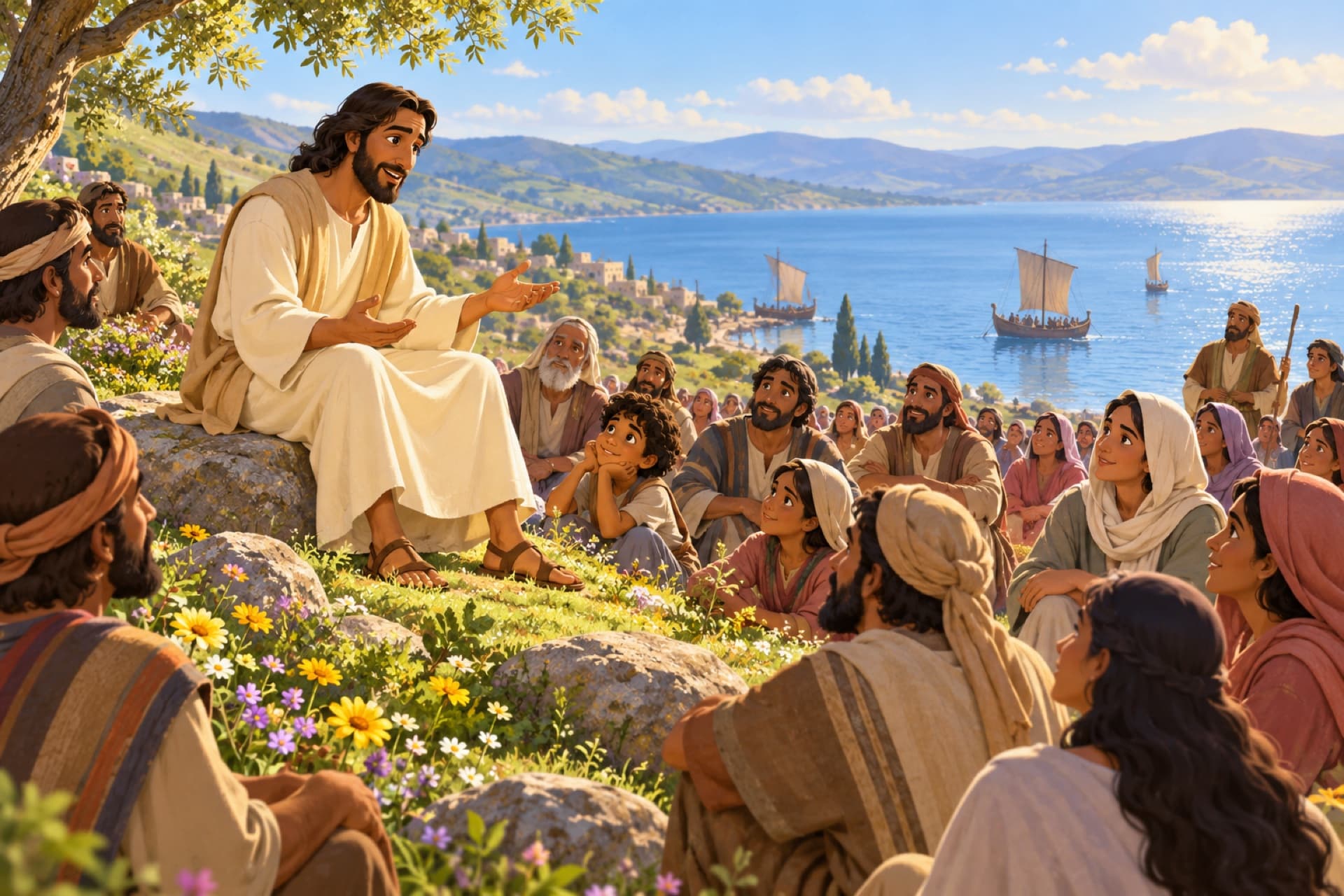
 The Evidence for Jesus · A lesson for grades 1–5
A real man
Big questionWas Jesus a real person?
By the end, kids can
- Give reasons historians are sure Jesus lived: writers who weren't Christians, names dug out of the ground, and thousands of careful copies.
- Know what Jesus said about himself, and why that means he can't be only a good teacher.
- Say the memory verse: John 1:14 (grades 3–4: John 20:31; grade 5: John 20:30–31).
You'll need
- The worksheet for each child's level (grades 1–2, 3–4, or 5), handed out at the start
- Bibles for the look-ups (grades 3–4)
- Pencils and crayons
- A screen with sound and internet: each test plays its part of the Chapter 3 video
The lesson
- 3 min Warm-up: how do we know?
- 3 min Memory verse
- 6 min Test 1, did he exist?: watch (2½ minutes), then talk
- 7 min Test 2, names in stone: watch (3 minutes), talk, and the worksheet
- 6 min Test 3, were the words kept?: watch (2½ minutes), then talk
- 6 min The big question, who did he say he was?: watch (2 minutes), talk, and look it up
- 4 min Put it together, crack the code, and a quick check
- 4 min Going deeper (grades 3–5): be the scholar, and legend, liar, lunatic, or Lord
- 3 min Good news: why it was written
- 3 min Memory verse again, talk, and pray
Worksheets
Print one for each child, at their level. They fill it in as you go: the ✎ Worksheet sticker on a slide says which part goes with it.
Answer key
Each worksheet page prints its answers upside down at the foot. Here they all are, and on the slide before the credits.
Grades 1–2
- Page 1: True or false? 1. T 2. F 3. T 4. F
- Page 2: John 1:14: Word, flesh, us
- Page 2: Crack the code! JESUS IS REAL
Grades 3–4
- Page 1: Time line: 1. The Romans crucify Jesus. 2. Josephus writes about Jesus. 3. Tacitus writes about Christus. 4. Archaeologists find Pilate's name carved in stone. 5. Workers find the bone box of Caiaphas.
- Page 2: John 20:31: written, believe, Messiah, life
- Page 2: Look it up! 1. Pontius Pilate 2. Caiaphas 3. the Pool of Siloam 4. Son, your sins are forgiven
Grade 5
- Page 1: Be the scholar: You are looking for Jesus the Nazarene, who was crucified. He has risen! He is not here. (5 slips)
- Page 2: John 20:30–31: signs, written, believe, Messiah, life
- Page 2: Think it through: Answers will vary. Look for: 1. Josephus 93, Tacitus 116 2. they happened; nobody invents shame 3. only God can forgive sins 4. he claimed to be God
Presenting
Each clue opens with a ▶ Watch slide that plays its part of the 12-minute Chapter 3 video right on the slide: read the two questions, then click (or press →, or use a clicker) to play the clip. The slides wait while it plays and stops by itself; click twice to stop it early. Then click to show the answers. The clips need an internet connection.
Click the slide, or press → or Space (a clicker works too), to show the next thing; ← goes back, even while a clip plays. F presents full screen (Esc leaves it). P opens the presenter view, a second window with your notes, the next slide, and a timer, that moves with the slides: put it on your laptop and the slides on the projector. N shows the notes under the slides.
Your script
A real man
Say: Last time we saw promises written long before Jesus come true in one man. Today's question: was that man real? And if he was, who was he?
Say: We'll run the same tests historians use on anyone from the ancient world.
How do we know?
Ask: How can we know someone from long ago was real? (Things they wrote, things other people wrote about them, things dug out of the ground.)
Say: The oldest surviving accounts of Alexander's life were written about 300 years after he died, and nobody doubts he lived. Keep that number in mind: 300 years.
Clicks: 1. the line “So how do we know he was real? Historians test the evidence. Today we'll test Jesus the same way.”
Sources: The oldest histories of Alexander
Memory verse
Do: Read it together three times. Then add motions: “the Word” (open your hands like a book), “became flesh” (pat your arms), “made his dwelling” (make a roof over your head), “among us” (point around the room).
Say: John calls Jesus “the Word.” This verse says God came to live among us as a real man, in a real place, at a real time.
Older kids: Grades 3–4 learn John 20:31 and grade 5 learns John 20:30–31. Both are on their worksheets.
Test 1 · Watch: Did he exist?
Say: Test one: did he exist? Let's hear what historians say, including some who aren't Christians.
Do: Read the two questions out loud, then click to play the clip. It's about 2½ minutes and stops by itself.
Ask after: What do nearly all historians agree on? Who wrote about Jesus without being a Christian? Click once for each answer.
Clicks: 1. play the clip (it stops by itself) · 2. the answer to 1: He lived, he gathered followers, and the Romans crucified him. · 3. the answer to 2: Tacitus, a Roman senator, or Josephus, a Jewish historian.
Sources: Historicity of Jesus · Tacitus on Jesus · Josephus on Jesus
Writers who weren't fans
Say: The written record starts fast. Jesus was crucified around AD 30. Within twenty or thirty years, Paul was writing letters we still have, and he had met Peter and “James, the Lord's brother.” For Alexander, remember, it was 300 years.
Say: Then come writers outside the church: Josephus around AD 93, and Tacitus around AD 116.
Ask: Why does it help that people who weren't Christians wrote about Jesus? (They had no reason to make him up. Tacitus didn't even like Christians.)
Clicks: 1. the line “The Jewish historian Josephus wrote about Jesus too, and about “the brother of Jesus, who was called Christ.””
Sources: Tacitus, Annals 15.44 · Josephus, Antiquities 18.63–64 · 20.200 (Whiston) · Galatians 1:18–19
Test 2 · Watch: Dug out of the ground
Say: Test two: did the writers get the small details right? People who make things up get names and places wrong.
Do: Read the two questions out loud, then click to play the clip. It's about 3 minutes.
Ask after: Whose name was in the stone? What did the workers find in 2004? Click once for each answer.
Clicks: 1. play the clip (it stops by itself) · 2. the answer to 1: Pontius Pilate, the governor who condemned Jesus. · 3. the answer to 2: The steps of the Pool of Siloam, where Jesus sent a blind man to wash.
Sources: The Pilate Stone · The Pool of Siloam · Mykytiuk, “New Testament Political Figures: The Evidence”
Names in stone
Say: Luke says John the Baptist began his work “when Pontius Pilate was governor of Judea.” This is the stone, carved while Pilate was alive.
Say: John's Gospel names the high priest at Jesus's trial: “Caiaphas, who was high priest that year.” In 1990, workers in Jerusalem broke into a family tomb and found his bone box.
Ask: Why would finding these names in stone matter? (It shows the Gospel writers had the right people in the right places.)
Worksheet: Grades 1–2 circle T or F on page 1 now. Grades 3–4 number the time line on page 1; the dates are in their story.
Worksheet answers: Grades 1–2, Page 1: True or false?: 1. T 2. F 3. T 4. F
Worksheet answers: Grades 3–4, Page 1: Time line: 1. The Romans crucify Jesus. 2. Josephus writes about Jesus. 3. Tacitus writes about Christus. 4. Archaeologists find Pilate's name carved in stone. 5. Workers find the bone box of Caiaphas.
Clicks: 1. the line “In 1990, workers found the bone box of “Joseph son of Caiaphas,” the high priest at Jesus's trial.”
Sources: The Pilate Stone · Luke 3:1 · The Caiaphas ossuary · John 11:49
Test 3 · Watch: Were the words kept?
Say: Test three: nobody has the original of any ancient book, only copies. So were the words kept? And did the writers tell the truth when it made them look bad?
Do: Read the two questions out loud, then click to play the clip. It's about 2½ minutes.
Ask after: How many Greek copies do we have? What embarrassing things did the writers keep? Click once for each answer.
Clicks: 1. play the clip (it stops by itself) · 2. the answer to 1: More than 5,800. · 3. the answer to 2: Peter said he didn't know Jesus; his friends fell asleep and ran away.
Sources: Textual criticism of the New Testament · Criterion of embarrassment · Mark 14
Copied with care, told straight
Say: Our oldest copy of Tacitus's report on Christus was made more than 900 years after he wrote it. A scrap of John's Gospel, Papyrus 52, is usually dated within about a century. More copies don't prove the events happened. They do show we know what the writers wrote.
Say: And look what they kept: Peter swears he doesn't know Jesus. His friends fall asleep while he prays. They all run away. His own family says, “He is out of his mind.”
Ask: If you were making up a story about heroes, would you put those parts in? (No. They kept them because they happened.)
Clicks: 1. the line “And the writers kept the stories that made them look bad. People don't invent those.”
Sources: Tacitus on Jesus · Papyrus 52 · Criterion of embarrassment · Mark 3:20–21
The big question · Watch: Who did he say he was?
Say: So he was real, and the writers were careful and honest. Now the biggest question: who did Jesus say he was?
Do: Read the two questions out loud, then click to play the clip. It's about 2 minutes.
Ask after: What did Jesus tell the man? Why were the teachers shocked? Click once for each answer.
Clicks: 1. play the clip (it stops by itself) · 2. the answer to 1: “Son, your sins are forgiven.” · 3. the answer to 2: Only God can forgive sins.
Sources: Mark 2:1–12 · John 8:58–59 · Mark 14:61–64
Not just a good teacher
Say: In the temple courts Jesus said, “Before Abraham was born, I am!” “I am” is the name God gave himself at the burning bush. His listeners knew it, and they picked up stones.
Say: C. S. Lewis, an Oxford scholar who had been an atheist, put it plainly: “You can shut Him up for a fool, you can spit at Him and kill Him as a demon; or you can fall at His feet and call Him Lord and God. But let us not come with any patronising nonsense about His being a great human teacher. He has not left that open to us.”
Ask: Who can forgive sins? (Only God. That's why the teachers were shocked.)
Worksheet: Grades 3–4 look up the four verses on page 2 now: Luke 3:1, John 11:49, John 9:7, and Mark 2:5.
Worksheet answers: Grades 3–4, Page 2: Look it up!: 1. Pontius Pilate 2. Caiaphas 3. the Pool of Siloam 4. Son, your sins are forgiven
Clicks: 1. the line “C. S. Lewis said he didn't leave us the choice of calling him just a great teacher.”
Sources: John 8:58–59 · Exodus 3:14 · Lewis, Mere Christianity
Jesus really lived
Say: Put the tests together. Nearly every historian agrees he lived. Writers who weren't fans wrote about him. The names the Gospels give keep turning up in the ground. And the words were kept, by writers who told the truth even when it hurt.
Worksheet: Grades 1–2 crack the code on page 2 now to find the secret message.
Worksheet answers: Grades 1–2, Page 2: Crack the code!: JESUS IS REAL
Clicks: 1. the card “Historians agree” · 2. the card “Writers who weren't fans” · 3. the card “Names in stone” · 4. the card “The words kept” · 5. the line at the bottom
Sources: Historicity of Jesus · The Pilate Stone · Textual criticism of the New Testament
True or false?
Do: Read each one and have kids stand up for true and sit down for false. Click to stamp each answer.
Answers: 1. False, Tacitus and Josephus did too. 2. True. 3. False, they kept them in. 4. True.
Clicks: 1. the answer to 1: False. Tacitus and Josephus wrote about him too. · 2. the answer to 2: True. · 3. the answer to 3: False. They kept them in. · 4. the answer to 4: True.
Be the scholar
Say: The agnostic scholar Bart Ehrman counts hundreds of thousands of differences among the manuscripts. Most are spelling and word order. Scribes rarely slipped in the same place, so with more than 5,800 Greek copies, a slip in one stands out against the rest.
Say: Ehrman trained under Bruce Metzger, a committed Christian. How far apart would they be on the original text? Ehrman: “very few points of disagreement, maybe one or two dozen places out of many thousands.”
Worksheet: Grade 5 lines up the three copies of Mark 16:6 on page 1 now, circles every slip, and writes what Mark first wrote.
Worksheet answers: Grade 5, Page 1: Be the scholar: You are looking for Jesus the Nazarene, who was crucified. He has risen! He is not here. (5 slips)
Clicks: 1. the line “Where they disagree, go with the two that agree. Every slip is outvoted.”
Sources: Textual criticism of the New Testament · Mark 16:6 · Ehrman, Misquoting Jesus (paperback), p. 252
Legend, liar, lunatic, or Lord?
Say: A legend? Tacitus and Josephus wrote about him, and his biggest claims are already in Mark, the earliest Gospel.
Say: A liar? Liars lie to get something. This claim got Jesus condemned and crucified, and he never took it back to save himself.
Say: A lunatic? Read the Sermon on the Mount: “Love your enemies and pray for those who persecute you.” Two thousand years later, the world still quotes it.
Say: If the other three don't fit, one is left: Lord. And God settled it by raising him from the dead.
Worksheet: Grade 5 answers the questions on page 2 now.
Worksheet answers: Grade 5, Page 2: Think it through: Answers will vary. Look for: 1. Josephus 93, Tacitus 116 2. they happened; nobody invents shame 3. only God can forgive sins 4. he claimed to be God
Clicks: 1. the card “A legend?” · 2. the card “A liar?” · 3. the card “A lunatic?” · 4. the card “Lord” · 5. the line at the bottom
Sources: Lewis's trilemma · Mark 14:61–64 · Matthew 5–7 · Romans 1:4
Why it was written
Say: The Gospel writers didn't write just to give us history. John says why he wrote: so that you would believe Jesus is the Son of God, and have life in his name.
Say: Jesus isn't a fairy tale. He's a real person you can know. The best way to meet him is to read about him. Mark is the shortest Gospel: about an hour.
Ask: When could you read some of Mark this week?
Clicks: 1. the line “Mark's Gospel takes about an hour to read. Read it, and meet him.”
Sources: John 20:30–31
Say it again
Do: Say the verse together, filling in the missing words. Then try it with eyes closed.
Answers: Word, flesh, us (the same words as the grades 1–2 sheet).
Worksheet: Everyone fills in their own memory verse on page 2 now and colors a star each time they say it.
Worksheet answers: Grades 1–2, Page 2: John 1:14: Word, flesh, us
Worksheet answers: Grades 3–4, Page 2: John 20:31: written, believe, Messiah, life
Worksheet answers: Grade 5, Page 2: John 20:30–31: signs, written, believe, Messiah, life
Clicks: 1. the missing word “Word” · 2. the missing word “flesh” · 3. the missing word “us”
Talk and pray
Do: Talk about one or two of the questions, then pray together. Kids can repeat the prayer one line at a time.
Say: Next time: if Jesus really was who he said, everything rides on one thing. Did he rise from the dead?
Clicks: 1. the prayer
Answer key
Do: Show this when kids check their work, or keep it on your laptop in the presenter view. Each worksheet page also prints its answers upside down at the foot.
Pictures and Scripture
Every picture on these slides, with its credit, license, and a link to its source.